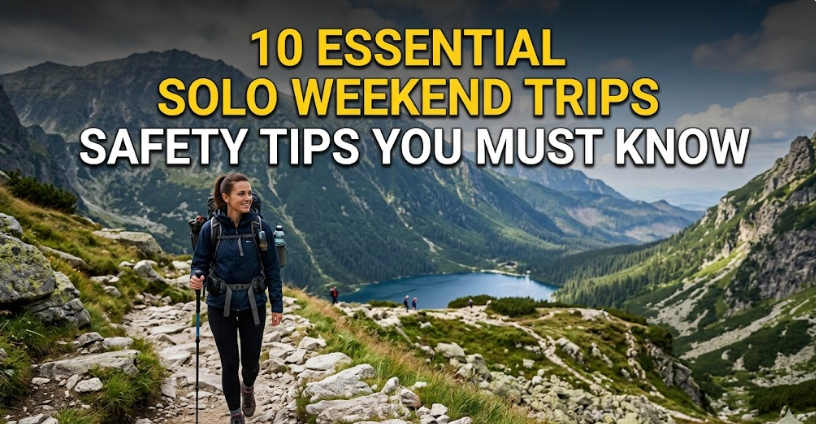
10 Safety Tips You Need to Know for a Solo Weekend Trip
Meta Description: Solo weekend trips can be exhilarating — but safety is crucial. Here are 10 essential safety tips for traveling solo with confidence, smart planning and peace of mind.
Imagine: you, your pack and an open road ahead. No group decisions. No waiting around. Just freedom.
Solo weekend trips are trending — and rightly so. They force you out of your comfort zone, make you recharge and teach you more about yourself than any group vacation ever could.
But here’s the thing that nobody wants to say out loud: going alone is also a real risk. Getting lost, losing your phone, staying in sketchy accommodations or not having someone to call in an emergency — these are not just worst-case scenarios. They are happening to real travelers every single weekend.
The good news? Most of the dangers you face while solo traveling are easily preventable with adequate preparation.
This guide shares 10 must-know solo weekend trip safety tips that are practical, easy-to-follow, and potentially life-saving. Whether you’re hiking a trail, roaming around an unfamiliar city or catching some sleep at a hostel — these tips are for you.
1. Always Tell Someone Your Whole Plan Before You Leave
This is rule number one of solo travel — and the most ignored.
Before you go, tell at least one person you trust everything:
- Where you’re going (specific destination, not just the city)
- A copy of your booking information (confirmation number, accommodation address, and reservations)
- Your travel route
- When you plan to return
- Emergency contacts at your destination
This person will be your “check-in buddy.” Schedule a time to send them a daily text. If they don’t hear from you, they’ll know something’s up.
Why This Move Might Save Your Life
When you’re lost, rescuers require a point of reference. Without a travel plan on file, that search can take days longer — and time is of the essence in emergencies.
A simple text message that includes the name of your hotel and return date can change everything. Don’t skip it.
2. Prepare a Smart Safety Kit — Not Just Clothing
Smart solo travelers are obsessed with safe packing.
Pack a small but powerful safety kit in your weekend bag:
| Item | Why You Need It |
|---|---|
| Portable phone charger | Dead phone = no GPS, no help |
| Small first aid kit (mini) | Most common problems are small cuts and sprains |
| Whistle or personal alarm | A loud noise can deter threats |
| Flashlight or headlamp | Power outages, dark trails, parking lots |
| Extra cash (small bills) | ATMs fail; cards get blocked |
| Copies of your ID/passport | Originals can be stolen |
| Offline maps (downloaded) | No data? No problem |
You don’t need a massive bag. Most of these items can be packed in a small pouch inside your larger bag. Pack light, but pack smart.
Don’t Forget Digital Safety Too
Before leaving, photograph your:
- ID or passport
- Credit/debit cards (front only)
- Hotel reservation confirmation
- Travel insurance card
Keep those in a private cloud folder — such as Google Drive or your email. You’ll still have everything you need in the event your wallet gets stolen.
3. Do Your Research Like a Local, Not a Tourist
It’s one thing to know where you’re going, and another to truly know your destination.
Tourists know the sightseeing spots. Safe solo travelers know which neighborhoods to steer clear of at night, where the closest hospital is and how local transport works.
Before Each Trip, Research the Following
- Crime rates by neighborhood: Google “[city name] safe neighborhoods” or visit local Reddit threads for honest insights.
- Local emergency numbers: Not everywhere uses 911. Get the number before you arrive.
- Common scams in the area: A quick YouTube search could save you money — and possibly more.
- Transportation tips: Research which ride-share apps are available, and whether taxis use meters or negotiated fares.
- Weather: A solo hike becomes genuinely dangerous when you don’t expect rain or flash flooding.
Thirty minutes of research before your trip is one of the best investments you can make in your own safety.
4. Pick Your Lodging With Safety as the #1 Priority
Where you sleep matters more than you think.
A bargain stay at a run-down hostel or a shady Airbnb in an out-of-the-way location can turn a fun weekend into a nightmare fast.
What to Look for in Safe Accommodation
For Hostels:
- Read recent reviews specifically about safety
- Check for available lockers to store your belongings
- Look for 24-hour reception desks
- Choose hostels in well-lit, central neighborhoods
For Hotels:
- Select rooms on the 3rd–6th floors (not too easy to access, not too high in an emergency)
- Always lock the door with both the deadbolt AND chain
- Always ask who is at the door before opening it
For Airbnbs:
- Only book listings with verified hosts and plenty of reviews
- Ensure there is a working smoke detector and clear emergency exits
- Send your check-in buddy the full address
A Quick Safety Check When You Arrive
When arriving in any new room, take 60 seconds to:
- Ensure every door and window locks properly
- Locate the nearest fire exit
- Note down the room number (for emergencies)
- Check for any hidden cameras (rare — but it does happen)
5. Keep Your Phone Charged and Your Location Shared
When you travel solo, your smartphone is your lifeline.
A dead phone in an unfamiliar city is a recipe for stress. A phone running out of battery on a backcountry hiking trail is a genuine emergency.
Build a Phone Safety Routine
- Keep your phone plugged in overnight until it reaches 100%
- Carry a power bank (10,000 mAh minimum for a full weekend)
- Download offline maps using Google Maps or Maps.me before leaving
- Enable location sharing with your check-in buddy
For iPhone users: Use Share My Location in Find My. For Android users: Use location sharing in Google Maps.
These features allow someone to track your location in real time — without you needing to send periodic updates.
The “Check-In” Rule
Set regular check-in times with your emergency contact. Something like:
“I’ll text you at 9 AM, 2 PM and 9 PM every day.”
Simple, consistent and reassuring for everyone involved.
6. Trust Your Gut — It’s Smarter Than You Think
This tip sounds soft. It isn’t.
Your gut instinct is your brain processing information faster than you can consciously think. When something feels off — a person, a place, a situation — your instincts are picking up on real signals.
It’s easy to ignore your instincts when you’re a solo traveler, especially if it’s your first time on the road and you don’t want to seem rude, paranoid or dramatic.
Don’t.
Real Situations That Call for Gut Instinct
- A stranger is being overly friendly and asking too many personal questions
- A driver takes an unexpected detour
- A “shortcut” through an alley doesn’t feel right
- Someone seems to be following you across multiple locations
- A room or building simply feels wrong
In all these situations, it’s perfectly fine to leave. It’s okay to be blunt. It’s perfectly acceptable to say “no” without giving a reason.
Safety is never rude.
The “Pre-Made Excuse” Trick
Many seasoned solo travelers keep a ready-made excuse for extracting themselves from uncomfortable situations:
- “My friend is waiting just around the corner.”
- “I need to take this call.”
- “I really have to get back to my hotel now.”
You don’t owe anyone an explanation. Whatever gets you out safely.
7. Be Mindful of Your Social Media Activity
Solo travel content looks beautiful on Instagram. But real-time posting while traveling alone can be dangerous.
What You Should Never Post in Real Time
- Your exact location (hotel name, address, neighborhood)
- That you’re traveling alone
- Your daily schedule or itinerary
- When your room or home will be empty
Posting a beautiful sunset photo? Fine. Tagging the exact beach with the caption “solo trip, just me and the waves all weekend”? That’s an invitation to the wrong people.
The 24-Hour Delay Strategy
Many savvy solo travelers follow this simple rule:
Post after, not during.
Take all the photos you want. Post them when you’re home — or at least after you’ve left that destination. Your feed will be just as beautiful, and you’ll be a lot safer.
Also review your privacy settings. Disable location services on your social media apps and ensure only people you trust can see your posts.
8. Strengthen Your Personal Safety Awareness
You don’t need a black belt to protect yourself. But having a few basics in place can make a significant difference.
Much of personal safety comes down to awareness, body language and de-escalation — diffusing a situation before it ever becomes physical. According to the U.S. Department of State’s travel safety guidelines, situational awareness is one of the most effective tools any traveler can develop.
Basic Skills Every Solo Traveler Should Have
Awareness:
- Keep your head up and eyes forward
- Avoid staring at your phone while walking in unfamiliar areas
- Sit facing the door in restaurants and cafes
- Identify exits whenever you enter a new space
Body Language:
- Walk tall and with purpose
- Make brief eye contact — it signals confidence
- Avoid looking lost or distracted in public
De-escalation:
- Stay calm and don’t engage in arguments
- If threatened, hand over your bag or wallet — possessions can be replaced
- Agree, disengage and leave as quickly as possible
Basic Physical Defense:
- Know how to break free from a wrist grab
- Use your voice — shouting “FIRE” often draws more response than “HELP”
- A keychain personal alarm (120+ decibels) can stop an attacker in their tracks
Even a single self-defense class before your first major solo trip is worthwhile. Many gyms offer weekend workshops specifically tailored to travelers.
9. Handle Money and Valuables Like a Pro
Theft is among the most common misfortunes solo travelers face — and one of the most preventable.
Golden Rules for Managing Your Travel Funds
- Diversify your cash: Never keep all your money in one place. Split it between your wallet, a hidden pouch and an inner zipper pocket in your bag. If one is taken, you’re not left stranded.
- Wear a money belt or hidden pouch: Worn under your clothes, these are virtually impossible to pickpocket. Use one for your passport and larger notes.
- Leave valuables at your accommodation: Don’t take your laptop, expensive jewelry or spare cards sightseeing. Use the hotel safe or hostel locker.
Be careful at ATMs:
- Use ATMs inside banks or shopping centers, not standalone street machines
- Cover the keypad while entering your PIN
- Never count your cash in public
What to Do If You Get Robbed
- Don’t fight back — your safety is worth more than your belongings
- Get to a safe, public area as quickly as possible
- Call your bank immediately to freeze your cards
- File a police report (required for insurance claims)
- If your passport was stolen, contact your embassy
10. Build a Real Emergency Plan — Before You Need One
Most solo travelers think: “If something goes wrong, I’ll figure it out.”
That’s not a plan. That’s wishful thinking.
A real emergency plan is specific, written down and communicated to someone who can take action.
How to Build Your Solo Travel Emergency Plan
Medical Emergencies:
- Know the local emergency number (911, 112, 999, etc.)
- Identify the nearest hospital or urgent care from your accommodation
- Carry a list of your medications and any allergies
- Purchase travel insurance that covers emergency evacuation
Natural Disasters:
- Familiarize yourself with your destination’s emergency alert system
- Know your accommodation’s evacuation route
- Follow local authority instructions immediately
Getting Lost:
- Download offline maps before you leave
- Know your accommodation’s address in the local language
- If all else fails, head to a police station, hotel lobby or large store for help
Lost or Stolen Documents:
- Have your country’s embassy or consulate address and phone number saved
- Keep digital backups of all documents in the cloud
- Report passport theft to local police and your embassy immediately
| Emergency Type | First Step | Second Step |
|---|---|---|
| Medical | Call local emergency number | Contact your travel insurance |
| Robbery | Get to safety | Call bank + file police report |
| Lost/Stolen passport | Call embassy | File police report |
| Natural disaster | Follow local alerts | Evacuate as directed |
| Getting lost | Use offline maps | Ask at a hotel or police station |
Quick Safety Checklist for Any Solo Weekend Trip
Save this to your phone before you go:
- [ ] Told my check-in buddy my full itinerary
- [ ] Shared my live location with someone I trust
- [ ] Downloaded offline maps for my destination
- [ ] Packed my small safety kit (charger, cash, first aid, alarm)
- [ ] Photographed all important documents
- [ ] Looked up local emergency numbers
- [ ] Researched the safety features of my accommodation
- [ ] Scheduled daily check-ins with my emergency contact
- [ ] Disabled real-time location sharing on social media
- [ ] Written down my emergency plan
Frequently Asked Questions About Solo Weekend Trip Safety
Q1: Is traveling alone safe for beginners? Yes — if you prepare properly. Stick to established tourist destinations, avoid remote areas and follow the tips above. Thousands of first-time solo travelers have safe, incredible experiences every single weekend.
Q2: What is the single most important thing to do before a solo trip? Tell someone your complete itinerary. This one step is the most important safety decision you can make. If something goes wrong, someone knows exactly where to start looking.
Q3: Any safety tips specifically for solo female travelers? All the tips in this guide apply to everyone. Additionally, research your destination’s reputation for women’s safety, consider women-only dorm options at hostels, dress in line with local cultural norms and trust your instincts without question.
Q4: Do I need travel insurance for a solo weekend trip? Absolutely. Even for short trips, travel insurance can cover medical emergencies, theft, cancellations and emergency evacuation. The cost is generally small relative to the protection it provides.
Q5: Which apps are best for solo travel safety?
- Google Maps (offline maps)
- Find My / Google Maps (real-time location sharing)
- bSafe (emergency SOS app)
- TripWhistle (local emergency numbers worldwide)
- Noonlight (emergency response app)
Q6: How do I avoid being targeted as a tourist? Walk with purpose, avoid checking maps visibly in public, dress similarly to locals when possible, don’t display expensive gadgets or jewelry and learn a few key phrases in the local language.
Q7: What should I do if I feel unsafe in my accommodation? Trust that feeling. Request a room change, check out early or move to a different property entirely. No deposit or booking fee is worth your safety. Most hotels will accommodate you if you explain your concern.
Wrapping It All Up
There are few things more rewarding than a solo weekend trip. The freedom, the self-discovery, the stories you’ll collect — they’re worth every bit of planning.
But none of that matters if you’re not safe.
The tips in this guide aren’t meant to deter you from traveling alone. They’re about giving you the knowledge and confidence to do it right.
Plan ahead. Stay aware. Trust your instincts. And make sure someone who cares about you always knows where you are.
The world is out there waiting for you. Go explore it — just be smart about it.