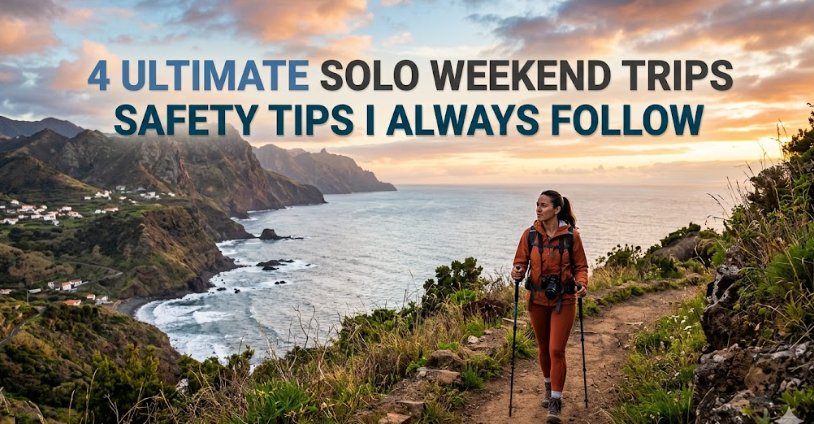
Meta Description: Solo weekend trips safety tips every traveler needs — discover 4 powerful, proven strategies to stay safe, confident, and prepared on your next solo adventure.
The 4 Safety Tips I Follow For Ultimate Solo Weekend Trips
Perhaps one of the most liberating experiences in life is travelling solo. You pick the destination. You set the pace. There is no argument over where to eat. But going solo also means there’s no contingency plan if things go awry — and that changes everything.
Over the years I’ve gone on dozens of solo weekend getaways. Mountains, coastal towns, strange cities, distant trails. I learned something different on each trip. And throughout it all, four fundamental safety tips have each stuck with me every time.
These aren’t vague tips you’ve read on every travel blog. They are real, practical habits that I actually practice — the type of things that have pulled me out of a rut on more than one occasion.
Whether this will be your first or fiftieth solo trip, these tips are meant to help you travel smarter, feel more confident, and return home with stories to tell.
Why Solo Weekend Trips Hit Different — And Why Safety Is More Important Than You Think
Most people picture solo travel as dangerous. The reality? It’s usually not. But the risk isn’t nonexistent, either.
If you’re traveling with a group, someone always notices you are missing. Someone holds the backup charger. Someone remembers to look at the weather. Alone, you are each of these people at once.
And that shift in responsibility is what makes solo travel so empowering — and why planning for safety is so vital.
Solo weekend trips are short. Two or three days. That may lead you to feel that no preparation is really necessary. However, someone who takes a short trip faces the same risks that come with taking a longer one. An ankle twisted on a trail still requires care. Having a dead phone in an unfamiliar city is no less of a problem. A not-so-great part of town after midnight is still a danger.
The good news? Even a small amount of preparation can go a long way.
Tip #1 — Always Tell Someone What You’re Doing, End-to-End
This sounds basic. Most people skip it anyway.
I text one trusted person a full breakdown of my plans before every solo weekend trip I take. Not “I’m going to the mountains.” I’m talking the whole enchilada — where I’m going to stay, how I am getting there, what I want to do each day, and when they can expect to hear back from me.
What Your Safety Contact Needs to Know
Here is precisely what I share with my contact before every trip:
| Information Type | What to Include |
|---|---|
| Destination | City, town, or area |
| Accommodation | Name, address, and phone number of hotel/Airbnb |
| Transportation | Flight numbers, bus routes, or car travel route |
| Daily Plans | Names of hiking trails, activities, locations, restaurants |
| Check-In Schedule | Specific times when I’ll text to let them know I’m safe |
| Emergency Contacts | Local emergency number; nearest hospital |
It takes about 10 minutes to put together. It could save your life.
Set a Check-In Schedule That Actually Works
The check-in schedule is the key part. I pick two times a day — in the morning and at night. If my contact doesn’t hear from me by a certain time, they know something isn’t right.
The trick is choosing an achievable time. If you say that you’ll check in at 7 AM but you’re a night owl who sleeps until 10, then that system is doomed. Find a version that works for your travel style.
I use a rudimentary code word system as well. If I send a particular word via text to my contact, they know to call local emergency services and provide them with my last known location. This sounds dramatic. I’ve never had to use it. But it makes me feel ten times safer just having it in place.
Who Should Be Your Safety Contact?
Pick someone who is:
- Reliable and responsive
- Calm under pressure
- Easy to reach at any hour
- So well acquainted with your habits that they can tell when something is amiss
A best friend, sibling, or parent typically works best. Do not opt for someone who regularly forgets to take calls or check messages.
Tip #2 — Pack a Solo Travel Safety Kit (Most People Never Think About This)
All solo travelers need a small, dedicated safety kit. Not a huge survival bag — just a little collection of stuff that solves common issues quickly.
I’ve constructed and refined my own for years. Here’s what’s always in it.
The Non-Negotiables in My Kit
A fully charged portable power bank. Your phone is your map, your translator, your emergency contact, your flashlight. If it dies, you lose all of those things at the same time. I have a power bank capable of fully charging my phone at least twice. I make sure to charge the power bank on the eve of every trip.
A basic first aid kit. Compact enough to carry in a daypack. Bandages, antiseptic wipes, pain relievers, blister pads, and any personal medications. You don’t have to be a paramedic to use a first aid kit — just having one means you can deal with the minor stuff before it becomes more serious.
A hard copy of critical information. Yes, on paper. Phone screens crack. Batteries die. Apps need signal. In my wallet, I keep a folded index card with my accommodation address, the phone number of my trusted contact back home, the local emergency number, and my travel insurance details.
A small flashlight or headlamp. Very useful on hiking trips, beach walks after dark, or to any place where street lighting is unreliable.
Personal safety device. This is contingent on what you feel comfortable with and on your local laws. Options include a loud personal alarm — entirely legal wherever you go, clips to a keychain — to other tools for personal protection depending on where you’re headed. At the very least, I carry a personal alarm.
What to Skip
Don’t overpack your safety kit. Heavy bags weigh you down and cause new issues. You don’t need a week’s worth of supplies for a weekend trip. Keep it tight, keep it light.
Solo Safety Kit — Key Components at a Glance
| Item | Why It Matters | Weight/Size |
|---|---|---|
| Portable power bank (10,000+ mAh) | Keeps your phone on all weekend | Small/medium |
| Basic first aid kit | Useful for cuts, blisters, and minor issues | Very small |
| Paper info card | Works when your phone doesn’t | Weightless |
| Headlamp or flashlight | Navigate in low light | Small |
| Personal alarm | Loud deterrent in unsafe situations | Keychain size |
| Backup cash | When cards fail, cash is king | Flat in wallet |
Tip #3 — Research Your Destination Like a Local, Not a Tourist
Most people only research hotels and restaurants. That’s a start. But safe solo travelers study something else — the real texture of a place.
Before every trip, I spend at least an hour learning things that guides never mention.
What Real Destination Research Looks Like
Safety by time of day at the neighborhood level. A neighborhood that is bustling and safe at noon may feel completely different come midnight. To understand what a place really feels like — not how it’s marketed — I rely on Reddit forums, local Facebook groups, and recent Google reviews.
Transportation options and their reliability. When my plan relies on public transport, I check to see if it runs on weekends. Schedules for many bus and train services undergo drastic changes on Saturdays and Sundays. I also note at least two alternative ways to get where I’m going if my top choice falls through.
Local emergency numbers. Not every country uses 911. Some destinations have separate numbers for police, fire, and medical emergencies. I look them up before I go and add them to my phone contacts and to my paper info card.
Common local scams targeting solo travelers. Every tourist destination has them. Fake taxi drivers. Overpriced unlicensed tour guides. Distraction pickpockets. A quick search for “[destination] common scams” before you leave takes five minutes and can save real headaches.
Weather and environmental hazards. Conditions can change quickly. A dry trail becomes dangerous after rain. I check the weather daily starting three days out, looking for any potential seasonal risks — flash floods, high tides, wildlife activity.
How to Actually Find Reliable Local Information
| Source | What It’s Good For |
|---|---|
| Reddit (r/travel or city-specific subs) | Honest first-hand accounts from recent visitors |
| Google Maps reviews | Street-level details about specific locations |
| Official tourism websites | General safety advisories and emergency contacts |
| Travel Facebook groups | Real-time advice from locals and frequent visitors |
| Government travel advisory pages | Country-level safety warnings for international trips |
Trust Your Research — And Your Instincts
Research gives you knowledge. But your instincts matter too. If something feels wrong when you arrive — a neighborhood doesn’t feel right, someone is making you uncomfortable, a situation isn’t adding up — trust that feeling. Traveling alone means no one else is there to second-guess your instincts. That’s actually an advantage.
For more ideas on planning your next getaway, Solo Weekend Trips is a great resource to explore destinations, itineraries, and travel tips built specifically for solo adventurers.
Tip #4 — Stay Connected Without Oversharing on Social Media
This one surprises people. Many solo travelers believe that staying safe means being visible online. In significant ways, it actually means the opposite.
The Hidden Risk of Real-Time Social Media Posts
By posting your location in real time, you’re informing strangers exactly where you are — and that you’re alone. That’s a risk most people don’t think twice about — until something goes wrong.
I enjoy posting about my travels on social media. But I have two simple rules that eliminate most of the risk.
Rule 1: Post only after you’ve moved on. That gorgeous café photo? I post it when I’m three blocks away or back at my hotel. The sunset at the lookout point? Goes up after I make it safely back to my accommodation. No one misses out on my travel content. I just share it with a small delay.
Rule 2: Don’t announce publicly that you’re traveling solo. It allows you to share awesome photos without broadcasting your solo status to everyone who sees your profile. Changing the way you caption things, just a little bit, goes a long way.
Staying Connected the Right Way
Being reachable is not the same as broadcasting your location. Here’s how I stay authentically connected while safeguarding privacy.
Download maps for offline use before you leave. Google Maps and Maps.me both allow offline downloads. Prior to my trip, I download the full map of the area where I’ll be. Even if I lose signal, I can still navigate. This has rescued me more times than I can count.
Share your live location privately. Most phones allow you to share your real-time location with specific contacts. I share mine with my safety contact for the entire duration of my trip. They can see exactly where I am at any time. Nobody else can.
Get a local SIM or an international plan. Roaming charges may discourage you from using your phone — meaning you go longer without checking in or looking things up. Either purchase a local SIM once you arrive or activate an international plan before your departure. Staying connected is worth the cost.
Know where the Wi-Fi spots are. Hotels, cafés, libraries, and visitor centers generally offer reliable Wi-Fi. I identify a few of these near my accommodation before I arrive. If anything goes wrong with my mobile connection, I know exactly where to go to get back online.
According to the U.S. Department of State’s travel safety guidelines, staying informed and maintaining reliable communication channels are among the most critical steps any solo traveler can take before heading abroad.
Quick Comparison: Safe vs. Risky Solo Travel Habits
| Habit | Safe Approach | Risky Approach |
|---|---|---|
| Social media | Post after leaving a location | Post your live location publicly |
| Phone battery | Carry power bank, charge nightly | Rely on phone battery alone |
| Location sharing | Share privately with one trusted contact | Share publicly or not at all |
| Navigation | Download offline maps in advance | Rely solely on live GPS with no backup |
| Check-ins | Scheduled, twice-daily contact | “I’ll text if something goes wrong” |
Bringing It All Together — How These Four Tips Work as a System
Each of these four tips is useful on its own. Together, they form a safety system that addresses nearly every scenario.
Your safety contact knows where you are. Your kit handles physical emergencies. Your research means you’re rarely caught off guard. And your connected-but-private approach keeps you reachable without making yourself a target.
Think of it as a four-layer safety net. If there is a gap in one layer, another catches you.
The best part? Once you’ve done this a few times, it becomes ingrained. You stop thinking of it as “safety planning” and start seeing it as simply how you travel. The habits become second nature. And with each solo trip you take, your confidence grows.
FAQs About Solo Weekend Trips Safety Tips
Q: Is solo travel really dangerous, or do people just think it is?
Solo travel is relatively safe — assuming you prepare properly. Statistics clearly indicate that most travel-related incidents are minor and preventable. Fear of danger is frequently worse than the actual threat. That said, being alone does mean you need to be more self-aware and better prepared than you might be in a group.
Q: What would be the number one solo travel safety tip for beginners?
Telling someone your entire plan before you go. Every other tip is predicated on having someone who knows where you are. This single habit removes a massive swath of solo travel risk.
Q: How do I pick safe accommodations when traveling alone?
Seek out 24-hour front desks, well-reviewed security, and central locations. Filter recent reviews by solo traveler — many booking sites allow you to do this. Avoid first-floor rooms in unfamiliar areas, and always make sure your room’s door locks securely when you arrive.
Q: Should I tell people I meet that I’m traveling alone?
Use your judgment. In casual situations such as guided tours or group activities, it’s generally fine. Be more careful in bars, at night, or with people you’ve just met. You could deflect the question naturally — “I’m meeting up with friends later” is a classic and effective response many solo travelers use.
Q: Which apps are most useful for solo travel safety?
Some of the more reliable ones are: Google Maps (offline navigation), bSafe (personal safety and check-in features), TripWhistle (local emergency numbers worldwide), and your phone’s native location sharing feature. A simple weather app and your bank’s card management app are also worth having on hand.
Q: What do I do if I have a medical emergency on a solo trip?
Learn the local emergency number before you go. Keep your travel insurance information on both your phone and paper. If you are on medication, make sure you have enough for the trip plus a little extra, and carry a note from your doctor if it’s a controlled substance. In a true emergency, hotel staff, other travelers, and local businesses are typically your best bet for quick help.
Q: Are solo weekend trips safe for women specifically?
Yes — with the same general preparation laid out in this article, plus a few added details. Familiarize yourself with your destination’s specific culture around solo female travel. Trust your instincts more aggressively. Look for female-only dorms in hostels. And join communities such as Girls LOVE Travel on Facebook for destination-specific, first-hand advice from other women.
Solo Travel Is Worth It — And You Can Do It Safely
Solo weekend trips are some of the best experiences you can have. The freedom is real. The growth is real. The memories are unforgettable.
But none of that is possible if you are not safe. And safety doesn’t require fear — it requires preparation.
Follow these four tips: tell someone your plans, pack a safety kit you’ll actually use, research your destination well, and stay connected without oversharing. Do those four things consistently, and you’ll travel with a sense of confidence that changes how you see the world.
The road is waiting. Go take it — just go smart.