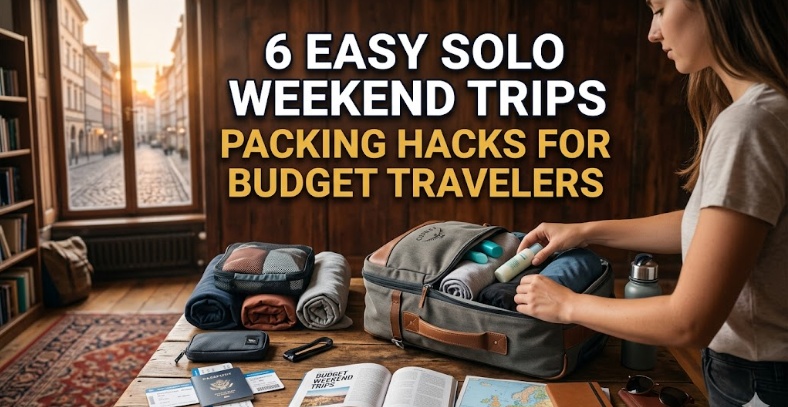
6 easy solo weekend trips packing hacks for budget travelers
There’s something quietly powerful about packing your own bag, locking your door, and stepping out alone for a weekend trip. No compromises, no waiting, no overthinking what someone else might need. Just you, your essentials, and a destination that feels like a small secret between you and the road.
But here’s the thing most people don’t talk about: packing can either make your trip feel light and freeing—or frustrating and expensive. Overpack, and you’re dragging your stress with you. Underpack poorly, and you’ll spend money fixing mistakes you could’ve avoided.
Over time, through trial, error, and a few chaotic weekends where I forgot things I absolutely shouldn’t have, I learned that packing smart is less about having more—and more about thinking differently.
This isn’t a list of generic advice. These are six practical, tested packing hacks that make solo weekend travel easier, cheaper, and honestly, a lot more enjoyable.
hack 1: pack outfits, not items
Most people pack by category. Two shirts. One pair of jeans. A jacket. Maybe another shirt just in case. It feels logical—but it creates a problem. You end up with pieces that don’t work together.
The shift that changed everything for me was simple: pack outfits, not individual clothing items.
Before you even open your bag, imagine your trip in moments. What will you wear when you arrive? What about a casual walk? A dinner? A lazy morning coffee? Suddenly, you’re not packing “clothes.” You’re packing ready-made decisions.
For a two-day trip, you usually need:
– one travel outfit
– one spare outfit
– one flexible layer
That’s it.
The magic lies in choosing pieces that mix well. A neutral t-shirt that works with both jeans and shorts. A light jacket that fits every situation. Shoes that don’t demand outfit changes.
When you pack this way, two things happen. Your bag becomes smaller. And your mind becomes lighter because you’re not making clothing decisions on the fly.
budget bonus insight:
When your outfits are pre-planned, you avoid buying emergency clothes during your trip—a surprisingly common budget leak.

hack 2: the “rule of one extra” (and nothing more)
There’s a fine line between being prepared and overpacking out of fear.
The rule of one extra is exactly what it sounds like. For anything essential—underwear, socks, maybe a t-shirt—you pack one extra. Not three. Not “just in case I spill something twice.”
One.
This rule forces you to be realistic instead of anxious. A weekend trip is short. You’re not going off-grid for a month. If something unexpected happens, you adapt. That’s part of solo travel anyway.
The mistake many travelers make is packing for imaginary scenarios. What if it rains? What if I change plans? What if I need something fancy?
Here’s the truth: most of those “what ifs” never happen. And if they do, they’re usually solvable without carrying extra weight everywhere.
There’s also a psychological benefit here. When your bag isn’t stuffed, you move differently. You feel more flexible. Less burdened. More willing to explore.
budget bonus insight:
Carrying less often means avoiding checked baggage fees, especially on budget airlines. It also saves you from impulse purchases just to “balance out” what you forgot.
hack 3: roll, layer, and use dead space
Folding clothes neatly looks satisfying—but it’s not efficient. Rolling is where things start to get interesting.
When you roll clothes tightly, you reduce wrinkles and create compact shapes that fit better together. But the real trick isn’t just rolling—it’s how you place those rolls.
Think of your bag like a puzzle.
Start with bulkier items at the bottom. Then layer rolled clothes around them. Fill every gap. Shoes shouldn’t just sit there—they should be filled with socks or chargers. Corners shouldn’t stay empty—they’re perfect for smaller items like toiletries.
This idea of using “dead space” is what separates a half-packed bag from a truly optimized one.
Another small but powerful detail: keep frequently used items at the top or in outer pockets. That way, you’re not unpacking everything just to find your phone charger at night.
budget bonus insight:
Efficient packing often means you can use a smaller bag. And smaller bags are cheaper, easier to carry, and less likely to attract attention in crowded places.
hack 4: build a compact essentials kit
There are items you’ll always need, no matter where you go. Instead of packing them fresh every time, create a ready-to-go essentials kit.
This could be a small pouch that lives inside your main bag. Inside it, you keep travel-sized versions of things like:
– toothbrush and toothpaste
– basic skincare
– a few medications
– a small deodorant
– a charging cable
The goal isn’t to carry everything. It’s to eliminate the mental effort of remembering small but important items every single trip.
Once this kit exists, packing becomes faster and more consistent. You just grab it and go.
A smart addition here is a tiny “problem solver” section. Think safety pins, a couple of band-aids, maybe a small laundry sachet. These weigh almost nothing but can save your day.
budget bonus insight:
Travel-sized items reduce weight and prevent overuse. You also avoid buying overpriced essentials at tourist spots.
hack 5: choose one versatile bag—and learn it well
Your bag isn’t just a container. It shapes your entire travel experience.
Many budget travelers make the mistake of constantly switching bags—sometimes a backpack, sometimes a duffel, sometimes a suitcase. The result? You never really master how to pack efficiently.
Pick one bag that fits weekend travel well. Ideally:
– carry-on friendly
– lightweight
– with a few smart compartments
Then stick with it.
Over time, you’ll develop a system. You’ll know exactly where everything goes. You won’t need to think twice about packing. And that familiarity reduces stress more than people expect.
There’s also a subtle benefit here. When you know your bag’s limits, you naturally pack less. You stop forcing things in and start prioritizing what actually matters.
budget bonus insight:
Avoiding new luggage purchases and sticking to one reliable bag saves money long-term—and prevents unnecessary clutter.

hack 6: pack for flexibility, not perfection
This is the mindset shift that ties everything together.
Many people pack as if their trip needs to go exactly as planned. But solo travel rarely works that way—and that’s part of the fun.
Instead of packing for perfect scenarios, pack for flexible ones.
Choose clothes that work in multiple situations. A shirt that looks casual during the day but works at night. Shoes that are comfortable for walking but still look decent in a café. A light layer that handles both cool evenings and overly air-conditioned spaces.
Flexibility also means being okay with repeating outfits. No one is paying as much attention as you think. And even if they are—it doesn’t matter.
When your packing supports flexibility, your trip becomes less rigid. You say yes to more things. You worry less about what you’re wearing or carrying.
budget bonus insight:
Flexible packing reduces the need for “backup” items, cutting down both weight and unnecessary expenses.
bringing it all together
Packing for a solo weekend trip isn’t about minimalism for the sake of it. It’s about intentional choices.
Every item in your bag should earn its place. Not because it might be useful—but because it clearly fits into your trip.
When you start applying these hacks together, something interesting happens. Packing becomes quicker. Your bag becomes lighter. And your travel feels smoother from the moment you leave home to the moment you return.
You spend less time managing your stuff and more time actually experiencing your trip.
And that’s really the goal, isn’t it?
not just packing—confidence
There’s a quiet confidence that comes from knowing you’ve packed well.
You’re not second-guessing yourself. You’re not worried about what you forgot. You’re not dragging unnecessary weight—physically or mentally.
Instead, you move freely. You explore without hesitation. You make decisions based on what you want—not what your luggage allows.
That’s what smart packing gives you. Not just convenience, but a better version of the same trip.
faq section
- how do i avoid overpacking for a short weekend trip?
Start by planning specific outfits instead of random clothing items. Stick to the rule of one extra for essentials and resist packing for unlikely “what if” scenarios. - is it better to use a backpack or a suitcase for solo weekend travel?
A compact backpack is usually more flexible and budget-friendly, especially if you’re moving around a lot. However, the best option is the one you’re comfortable using consistently. - how can i save money through better packing?
Packing efficiently helps you avoid baggage fees, reduces the need to buy forgotten items, and minimizes impulse purchases during your trip. - what should i always include in my essentials kit?
Basic toiletries, a charging cable, small medications, and a few emergency items like band-aids or safety pins are usually enough for a weekend. - how do i keep my clothes wrinkle-free while packing light?
Rolling clothes tightly and layering them properly inside your bag helps reduce wrinkles and saves space at the same time. - is repeating outfits during a weekend trip okay?
Absolutely. Weekend trips are short, and most people won’t notice or care. Prioritize comfort and practicality over variety.
In the end, packing isn’t just a preparation step. It’s the foundation of how your trip unfolds. Get it right, and everything else becomes easier.