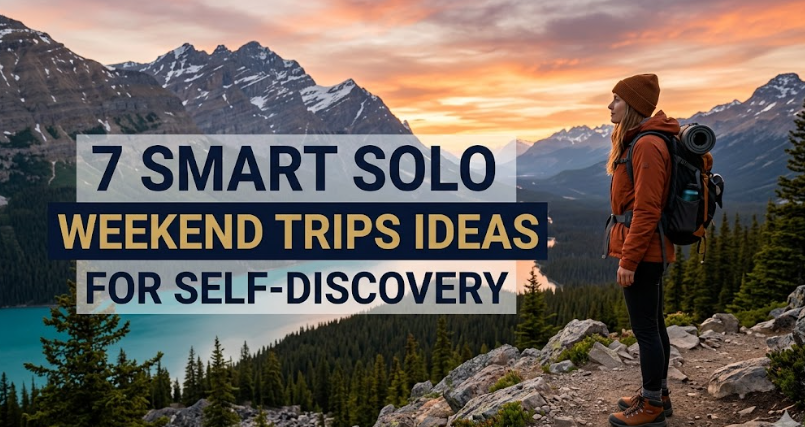
Solo Weekend Trips for Self-Discovery
Solo weekend trips for self-discovery provide you with the rarest gift: uninterrupted time, just for you, to reconnect with yourself and clear your head — not to mention returning home feeling grounded.
7 Wisdom Weekend Trips to Discover Yourself as a Single
There’s something potent about packing a bag, walking out the door solo and giving yourself two blank days that no one else gets to fill.
Solo weekend trips for self-healing are more than a travel trend. They’re one of the most straightforward, inexpensive tools there are for checking in with yourself. No group decisions. No compromises. It’s just you, a destination and what will you do with it.
Whether you’re fried from work, feeling stagnant or just in search of some quiet, a solo weekend away can reset things more quickly than you’d think. And you don’t have to fly around the world to make it meaningful.
This guide walks you through seven particular trip ideas that can do more than just entertain you — they teach you something real about who you are.
Why Going Alone Really Does Make a Difference
Most of us spend our leisure time in the company of others. That’s not a bad thing. But constant social interaction means you seldom hear your own thoughts clearly.
When you take a solo journey, it changes. You make every decision. You deal with every challenge. You sit with yourself at dinner, noting what you’re really feeling.
That’s not uncomfortable — at least, it doesn’t have to be. It’s clarifying.
Research on solo travel consistently finds that people come back from solo trips more confident, less anxious and with a clearer idea about what they want.
How to Choose the Right Solo Trip for You
Before diving into this list, ask yourself one really honest question: What do I actually need right now?
| If you’re feeling… | You might need… | Best trip type |
|---|---|---|
| Burned out and exhausted | Rest and zero pressure | Cabin retreat or beach town |
| Mentally foggy or stuck | Perspective and movement | Hiking or road trip |
| Disconnected from yourself | Reflection and creativity | Artistic town or writing retreat |
| Craving something new | Challenge and exploration | New city solo adventure |
| Spiritually low | Quiet and meaning | Nature immersion or monastery stay |
None of this is a strict rulebook. It’s a starting point. Use your gut.
1. The Solo Cabin Weekend — Just You and Total Silence
What it looks like
Find a cabin or small cottage in a wooded or rural area. No group activities. No itinerary. A couple of books, simple food and honest silence.
Most people find this the most difficult kind of trip at first. Without a phone to scroll through and people to talk to, you’re forced to confront your own thoughts. That’s the whole point.
What you’ll discover
After the initial restlessness, something softens. You begin to notice little things — the sound of rain, how you feel when you have a slow morning, what it is that you actually want to do versus what you just do as default.
A surprising number of people return from cabin weekends with newfound clarity about decisions they were not making.
Tips to make it work
- Tell a single person where you will be, and then mute the group chat
- Bring a physical journal, not a notes app
- Let yourself be bored — that’s where the good stuff is
- Don’t plan every hour; intentionally leave large empty spaces
Best for: Those with mentally cluttered brains who need a total halt.
2. Hiking Alone — Get Moving and Be Still
The reason hiking is so effective for self-reflection
There’s a reason so many “finding myself” tales are set in the mountains or on trails. Walking is rhythmic, and it mirrors thought. Long stretches during which nothing needs your attention but the road.
When you hike by yourself, you stop when you want to. You sit down on a rock and look at a valley for fifteen minutes. Nobody’s waiting.
What a solo hiking weekend is like
Take a trail system within a few hours of home. Reserve a nearby lodge or campsite. Hike both days at whatever speed feels appropriate.
Don’t push so hard that it becomes a fitness event. This isn’t training. It’s thinking with your legs time.
What you usually discover on the trail
Most hikers report that by about hour two or three, their mind starts going to the things they’ve been avoiding. Decisions get clearer. Old worries shrink in proportion.
It’s partly the physical movement, partly being out of proximity of screens, and partly having extended periods of time with nothing demanding your attention.
Staying safe solo
- Send your itinerary to someone before you head out
- Download offline maps — don’t rely on cell service
- For beginners, stick to well-marked, popular trails
- Bring a basic first-aid kit and extra water
Best for: Anyone who needs to process an issue, not only sit with it.
3. A Solo Creator’s Weekend — Create Something Audience-Free
The idea behind this trip
Choose a place with an arts or craft destination — a small arts town, a pottery studio that hosts weekend workshops, a city with good independent galleries. Bring a creative project, or just bring open hands.
The secret here is to make something you’re not going to show anyone. A sketchbook no one will see. A poem written in a café. A curated playlist made in a hotel room.
Why no audience matters
Creating without an audience shows you what you really like. Most of us create things with at least one ear tuned into how others will react. Remove that, and you discover a lot about your taste and your intuitions.
What to bring
- A sketchbook, notebook, or instrument
- No desire to come up with something “good”
- Willingness to waste supplies on bad experiments
- Curiosity about what you are attracted to when no one else is looking
Where to go
Seek out towns with vibrant local art communities, active artist studios open to visitors, or weekend craft workshops in ceramics, weaving or printmaking. These exist in most regions and usually cost very little.
Best for: Those who are creatively blocked or disconnected from things that used to inspire them.
4. A Solo City Getaway — Explore New Places on Your Own Terms
How a city trip feels different when you’re on your own
When you visit a city by yourself, you have to engage more fully. You can’t defer to someone else’s restaurant choice. You read the map yourself. You decide what’s interesting.
This may seem a trivial point, but it is transformative. You stop waiting for somebody to recommend the next thing. You start to lean into what you actually want to see, eat and do.
How to do it right
Don’t over-plan. A loose structure works best. Choose one or two neighborhoods you’re interested in. Book a good breakfast spot. Other than that, follow your interest as it unfolds in real time. Wander. Step inside the bookshop that appeals to you. Sit in a park and watch people.
Pay attention to what interests you when no one is looking.
The self-discovery angle
When traveling alone, most people are surprised by what captures their interest. You may find that you love slow mornings at local markets, or that you’re more attracted to quiet residential neighborhoods than so-called hotspots, or that reading in an out-of-the-way café is your key to contentment.
These are actual data points about who you are.
Practical solo city tips
| Task | Solo travel tip |
|---|---|
| Safety | Keep your hotel card in your pocket, not just on your phone |
| Meals | Sit at the counter or bar — it’s easier and often better service |
| Navigation | Download the city map offline before you get there |
| Loneliness dips | It happens to everyone — keep a journal for when it comes |
| Spontaneity | Say yes to one thing that might ordinarily make you cringe |
Best for: Those looking to rediscover their own tastes and intuitions.
5. A Solo Nature Immersion Weekend — Reconnect at Ground Level
What this is and isn’t
This is not a hiking trip. Nature immersion is slower, less destination-driven. The goal isn’t to summit something or go for distance. It’s to spend long hours outdoors with minimal agenda.
Think: a tranquil campsite by a lake. An off-season beachside cottage. A forest cabin where you can sit outside for two hours without having to go anywhere.
Why nature does what therapy often can’t
There’s solid research on this. According to the American Psychological Association, time spent in natural environments reduces cortisol, quiets mental chatter and shifts the nervous system into a calmer state. This is not metaphor — it’s physiology.
When you sit by water, walk barefoot on grass or stare at a fire for an hour, your brain enters a different mode. The endless feedback loop of problem-solving shuts down.
What to do with the silence
Don’t bring anything digital unless you need it for safety. Bring a journal. Bring something you want to read. Sleep when it gets dark. Wake up when it gets light.
Notice what you are thinking about in the first hour, the second hour, and at the end of the day. The quality of thinking shifts meaningfully with 48 hours of actual nature time for most people.
Best for: Those who have run on stress too long and need a nervous system reset.
6. A Solo Writing or Journaling Retreat — Tell Yourself the Truth
The premise
You don’t need an elaborate retreat center. A quiet room, something to write with, and the desire to be honest.
Reserve a small inn or an Airbnb in a quiet out-of-the-way town. Bring several journals or a laptop. Set aside a weekend to write — not for an audience, not directed at a project, but as a way of figuring out what you actually think.
Prompts to take with you
Sometimes the blank page is the hardest part. Here are some prompts that tend to go to the core:
- If I wasn’t afraid about what people thought of me, what would I do?
- What have I been ignoring that I need to confront?
- What did I care about at 12 that I’ve completely forsaken?
- What would the next chapter of my life need to be, if it were a book?
- What do I always almost decide but never quite follow through on?
These aren’t therapy questions. They are simply invitations to put yourself in writing, which is easier than putting yourself into words.
Why writing works
There’s something about writing words down on paper that demands specificity. Vague anxieties become concrete. Muddled emotions become articulate words. Often you find out what you think by reading what you’ve written.
Best for: Someone moving through a big life transition, decision or unnamed emotional burden.
7. A Town, and Something Bigger Than Your Story
What this trip is about
Select a town or small city with rich cultural history — where people have lived, created, struggled and made meaning for ages. Spend the weekend museum-hopping and wandering around historic sites, local food markets and neighborhoods.
The purpose isn’t sightseeing. It’s perspective.
How it shifts your thinking
When you dwell with history, art and culture that have nothing to do with your own situation, something interesting happens. Your problems get proportionately smaller. Your sense of what’s possible is often stretched.
You feel it — that humans have been figuring things out for thousands of years. That people have made courageous decisions, gone through difficult moments and created something worth experiencing. That awareness can change the way you carry your own story.
What to look for
- Local museums with strong permanent collections
- Historic neighborhoods with original architecture
- Farmers’ markets or traditional food halls
- Independent bookshops (good for an hour)
- Public events — festivals, open studios, local music
Go slowly. Don’t try to see everything. Sit with what moves you.
Best for: Those feeling too invested in their own micro issues, needing a broader lens.
Practical Matters to Organize Before You Go
The checklist most people skip
Solo travel is much easier than traveling in a group. But there are a few things worth sorting before you set off.
Before the trip:
- Inform one trusted person of your destination and return date
- Store your lodging address offline (not only in a cloud)
- If traveling internationally, research the local emergency number
- If you’re using a card, tell your bank you’ll be traveling
- Save maps offline for your destination
Things to bring for a self-exploration weekend:
- A physical journal and pen (not only a notes app)
- A book you’ve actually been wanting to read
- Comfortable walking shoes
- Minimal screens — only what you really need
- Some cash for local places that don’t take cards
What to leave behind:
- The urgent-but-not-important work emails
- The social media obligation to share everything you do
- Any agenda that doesn’t serve the true purpose of the trip
What to Do When Loneliness Strikes
It will, at some point. Typically by the first night or the second morning.
This is completely normal. It doesn’t mean solo travel isn’t for you.
Loneliness on a solo trip is not the same as loneliness at home. At home, loneliness is the absence of something. On a solo journey, it usually means you are about to receive something real.
Instead of immediately filling it with noise, sit with it for a moment. Write in your journal. Take a slow walk. Get something good to eat and just be there with it.
Most solo travelers say that once they got through the initial jolt of loneliness, the trip began to unfold in ways they didn’t expect.
Questions and Answers About Solo Weekend Getaways for Self-Discovery
Q: Is it safe for a first-timer to travel alone? Yes, with reasonable preparation. Pick well-reviewed destinations, keep someone you trust in the loop about your plans and travel to a region you know reasonably well. The perceived risk of traveling alone is almost always greater than the actual risk.
Q: What is a reasonable distance for a solo weekend trip? Far enough to feel like you’re actually away, but close enough that travel doesn’t consume the entire weekend. The ideal distance is usually two to four hours from home. Distance is not what matters — the break from daily routine is.
Q: Do I need to quit my phone altogether to reap the benefits? No. Total detox isn’t right for everyone. The key is intentionality. Turn off work notifications. If you need to, limit social media to one check-in a day. But don’t feel like your trip doesn’t count if you have your phone with you.
Q: What if I experience loneliness or anxiety when traveling alone? These feelings are entirely normal, especially the first time. They generally pass within the first 24 hours. Bring a journal and write through them. Pick somewhere with a little social energy — a small town café or a hostel common room — if total solitude feels like too much.
Q: What is the price tag on a solo self-discovery weekend? It depends on what you choose. A weekend camping or in a cabin can be inexpensive. A city hotel on the weekend will cost more. Most of the trips covered in this guide can be achieved for $150–$400 all in (accommodation, food and transport). It is not an experience about money.
Q: What if I have children or obligations and cannot leave for a weekend? It’s real, and it requires planning. Start small — even a night away alone can change things. Speak frankly with a partner or family member about why you need it. Most people find their loved ones are more supportive than they had feared.
Q: Must I have a reason for the trip, or can I just go? You can absolutely just go. But having even a vague intention — “I want to figure out what I want for the next chapter of my life” or “I just need to rest completely” — helps you make the most of that time. It doesn’t need to be deep. It just needs to be honest.
Just So You Know Before You Book
The best solo weekend trip is one that you actually take.
It doesn’t have to be perfect. The cabin doesn’t require five stars. The trail doesn’t have to be legendary. The city doesn’t need to be on anyone’s bucket list.
What matters is that you are there — alone, on purpose — and that you allow yourself the space to discover what you really think, want and need.
Going away solo for a weekend of self-discovery isn’t daring. It just requires a decision.
Make it.
Whatever you need right now, plan your weekend around that — and you’ll return different, for good.