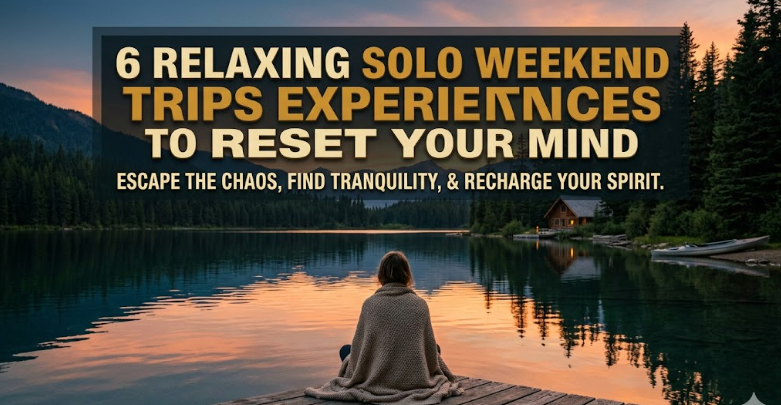
6 relaxing solo weekend trips experiences to reset your mind
There comes a point when noise stops being something you hear and starts being something you carry. It lives in your shoulders, in the way you check your phone without thinking, in how quickly silence becomes uncomfortable. A solo weekend trip, when done right, is less about escape and more about recalibration. It’s a deliberate pause. A reset button that doesn’t ask permission.
What follows isn’t a list of destinations in the traditional sense. These are experiences—small, intentional journeys you can shape around your own pace. Each one is built on a simple idea: remove what overwhelms, amplify what soothes, and let your mind catch up with your life.
the quiet cabin with no agenda
There is something almost unsettling about arriving somewhere and realizing you have nothing you have to do. No itinerary. No list. Just time stretching out in front of you like an empty page.
A quiet cabin—whether in the hills, near a forest, or by a lake—creates that rare condition where boredom transforms into clarity. The first few hours might feel strange. You may reach for your phone more than usual. You might wonder if you should “do something productive.”
Don’t.
Let the stillness settle in.
On the first evening, keep things simple. Cook something easy, even if it’s just eggs and toast. Eat slowly. Notice the absence of background noise. Notice how different food tastes when you’re not rushing through it.
The next morning, wake up without an alarm. This alone can feel like a luxury you didn’t know you missed. Step outside. Breathe in air that hasn’t passed through crowded streets or enclosed spaces. Even if you’re not surrounded by dramatic scenery, the act of stepping out into open space shifts something internally.
By midday, something subtle begins to happen. Your thoughts slow down. They become less reactive, more reflective. Ideas that were buried under daily urgency start to surface. Not all of them will be useful, but that’s not the point. The mind, like a cluttered room, needs time to sort itself.
Spend part of the day doing nothing intentionally. Sit with a book you don’t feel pressured to finish. Write in a notebook without worrying about structure or grammar. Watch how light moves across the floor.
By the second evening, the silence won’t feel empty anymore. It will feel full—of presence, of awareness, of a kind of calm that doesn’t need to be earned.
the slow coastal walk
Water has a way of absorbing tension. Even watching it can quiet the restless parts of your mind. A solo trip to the coast isn’t about sightseeing; it’s about rhythm.
Arrive early enough to catch either sunrise or sunset. These transitional moments matter more than you think. They create a natural pause in the day, a reminder that not everything runs on your schedule.
Start with a long walk along the shore. Not a brisk one. Slow your pace deliberately. Match your breathing to your steps. Listen to the repetition of waves—not as background noise, but as something you tune into.
Leave your headphones behind.
At some point, you’ll notice that your thoughts start syncing with your movement. Problems that felt tangled begin to unravel, not because you’re trying to solve them, but because your mind is finally given space to process them.
Sit down at some point—on a rock, on the sand, anywhere comfortable. Watch the horizon. It’s one of the few visual experiences that expands your sense of space. When your eyes adjust to that openness, your thoughts tend to follow.
If you can, spend time near the water at night as well. The sound changes. The atmosphere shifts. There’s a deeper kind of stillness that settles in, one that feels almost meditative without effort.
Eat something simple from a local place. Sit alone without distraction. Notice how different solitude feels when it’s chosen rather than imposed.

the digital detox retreat
Most people underestimate how much mental energy is consumed by constant connectivity. Notifications, messages, updates—they fragment your attention in ways you don’t fully notice until they’re gone.
A digital detox weekend is exactly what it sounds like: a deliberate break from screens. Not partial. Not “just checking once in a while.” A full pause.
Start by setting expectations before you leave. Inform the people who might need to reach you. Remove the anxiety of being unavailable.
When you arrive, turn your phone off or put it somewhere out of immediate reach. The first few hours will feel uncomfortable. You might experience phantom notifications or an urge to check something without knowing what.
This is normal.
Replace digital habits with physical ones. Read a physical book. Write by hand. Take walks without documenting them. Cook without following a video tutorial.
Pay attention to how your focus changes. Without the constant pull of screens, your attention becomes deeper, more sustained. Tasks that once felt boring might become absorbing.
Sleep will likely improve as well. Without late-night scrolling, your mind has a chance to wind down naturally. You may find yourself waking up feeling more rested than usual, even if you didn’t sleep longer.
By the end of the weekend, you’ll notice something subtle but significant: your thoughts feel less scattered. There’s a coherence that returns, a sense that your mind is working with you rather than against you.
the nature immersion escape
There’s a difference between being near nature and being in it. A nature immersion trip goes beyond scenic views. It’s about engaging your senses fully.
Choose a place where you can spend extended time outdoors—trails, forests, open fields. The goal isn’t to cover distance but to deepen experience.
Start with a simple walk. Pay attention to details you usually ignore—the texture of leaves, the sound of insects, the way light filters through branches. These small observations anchor you in the present moment.
Try grounding exercises without overcomplicating them. Sit on the ground. Feel the temperature, the texture. Let your body register where you are physically.
Eat outdoors. Even something as simple as fruit or bread can feel different when you’re fully present with it. Notice flavors more carefully.
If possible, include a period of complete silence. Not forced meditation, just quiet presence. Let your mind wander without guiding it.
You may find that emotions surface unexpectedly. Nature has a way of bringing things up—not in a dramatic way, but in a gentle, persistent one. Let them pass without analysis.
At night, if the setting allows, spend time under the open sky. The absence of artificial light changes your perception. It creates a sense of scale that’s hard to replicate elsewhere.
the solo city wander
Not all relaxation comes from isolation. Sometimes, being alone in a busy place can be just as grounding—if approached differently.
A solo city wander is about moving through a familiar or unfamiliar city without purpose. No checklist. No rush.
Start your day at a café. Sit alone with a drink and simply observe. Watch people, notice interactions, listen to ambient sounds. This kind of passive observation can be surprisingly calming.
Walk through streets without using navigation constantly. Let yourself get slightly lost. Discover places you wouldn’t have planned to visit.
Visit spaces that encourage quiet reflection—bookstores, parks, small galleries. Spend time without feeling the need to move quickly.
Eat at a place where you feel comfortable sitting alone. This can be challenging for some, but it’s also empowering. Notice how your awareness shifts when you’re not focused on conversation.
Carry a notebook. Write down thoughts as they come, even if they seem trivial. Over time, patterns may emerge.
The key to this experience is intentional slowness. Cities are designed for movement, for efficiency. Choosing to slow down within that environment creates a unique contrast that can reset your perspective.
the mindful wellness retreat
Sometimes, you need structure to truly relax. A mindful wellness retreat provides that structure without overwhelming you.
Look for simple programs—yoga sessions, guided meditation, breathing exercises. Nothing too intensive. The goal is support, not pressure.
Arrive with an open mind. You don’t have to fully believe in every practice. Just engage with curiosity.
Start with breathing exercises. They’re often underestimated, but they directly influence your nervous system. Slow, deliberate breathing can reduce tension quickly.
Participate in group sessions if available, but maintain your sense of solitude. You’re there for yourself, not for socializing.
Take advantage of quiet spaces. Sit with your thoughts between sessions. Let the practices integrate naturally rather than forcing results.
Eat mindfully. Many retreats emphasize slow eating, which can be more impactful than expected. It brings awareness to something you do every day without thinking.
By the end of the weekend, the combination of structure and solitude often creates a balanced reset. You leave not just relaxed, but equipped with tools you can carry into daily life.
bringing the reset back home
A weekend trip ends, but its effects don’t have to. The real challenge is maintaining some of that clarity when you return to routine.
Start small. You don’t need to recreate the entire experience. Choose one or two elements that resonated with you.
Maybe it’s waking up without immediately checking your phone. Maybe it’s taking short walks without distractions. Maybe it’s setting aside time for quiet reflection.
The goal isn’t to escape your life repeatedly. It’s to integrate moments of calm into it.
Over time, you may find that the need for a full reset becomes less urgent. Not because life gets easier, but because you’ve learned how to create space within it.
And that’s the real value of these solo weekend experiences. They don’t just offer temporary relief. They show you what your mind feels like when it’s not overwhelmed—and remind you that this state is always within reach.
frequently asked questions
- is it safe to travel alone for a weekend trip?
Yes, solo travel can be safe if you plan carefully. Choose locations you’re comfortable with, inform someone you trust about your plans, and stay aware of your surroundings. Trust your instincts and avoid unnecessary risks. - how do i deal with loneliness during a solo trip?
Loneliness can appear, especially at the beginning. Instead of resisting it, acknowledge it. Often, it fades as you become more engaged with your surroundings. Activities like journaling, walking, or simply observing your environment can help. - what should i pack for a relaxing solo weekend?
Keep it minimal. Comfortable clothing, a book, a notebook, basic essentials, and anything that supports your chosen experience. Avoid overpacking, as simplicity contributes to relaxation. - do i need to plan everything in advance?
Not necessarily. Having basic arrangements like accommodation is important, but leaving space for spontaneity can make the trip more refreshing. Flexibility often leads to better experiences. - how often should i take solo trips like this?
There’s no fixed rule. Even once every few months can make a noticeable difference. The key is consistency rather than frequency. - can these experiences work on a low budget?
Absolutely. Many of these ideas—like nature walks, digital detox weekends, or city wandering—require very little spending. The focus is on mindset and approach, not luxury.
A solo weekend trip doesn’t need to be extraordinary to be effective. In fact, the simpler it is, the more space it creates for what truly matters: your thoughts, your pace, your presence.