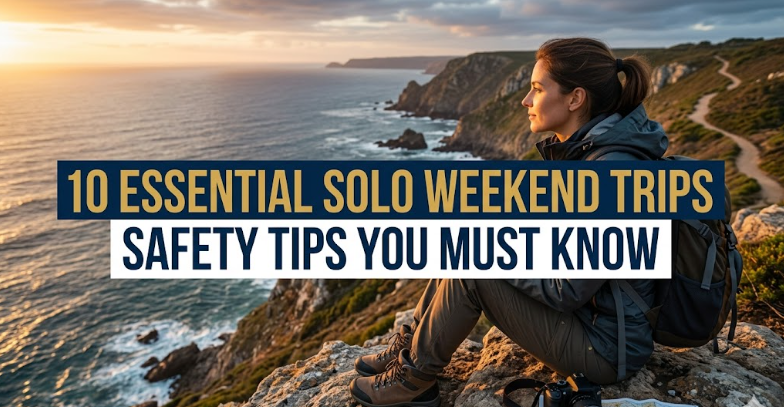
10 Essential Solo Weekend Trips Safety Tips You Must Know
There is a particular kind of freedom that comes with packing a small bag on a Friday evening, locking the front door behind you, and leaving for a weekend with no one else’s schedule to follow. No debates over where to stop for tea. No compromises about what to see first. No waiting for someone to get ready. Just a destination, a little curiosity, and the quiet thrill of moving at your own pace.
Solo weekend travel has become one of the easiest ways to reset without taking a long break from work or spending weeks planning a major trip. It offers the pleasure of escape in a form that feels manageable. A short train ride to a nearby city. A mountain guesthouse two hours away. A coastal town with empty morning streets and late sunsets. Even a one-night stay in a place you have never seen before can change your mood in ways that are difficult to explain and easy to feel.
But solo travel, even for just a weekend, asks something important of you: awareness.
When you travel alone, you become your own planner, navigator, decision-maker, and first line of protection. That does not mean solo travel is dangerous. It means safety becomes part of the journey in a more direct and personal way. The goal is not to become fearful or overly cautious. The goal is to become prepared enough that you can actually relax.
That is the difference most experienced solo travelers understand well. Safety is not the opposite of adventure. It is what allows adventure to remain enjoyable.
A safe solo weekend trip is not built on paranoia. It is built on habits. Quiet, practical habits. The kind that reduce risk without reducing joy. The kind that let you stay spontaneous while still staying smart.
The good news is that solo weekend safety does not require complicated systems or expensive gear. Most of it comes down to paying attention, making a few solid decisions in advance, and trusting the value of simple precautions.
The ten tips below are not dramatic. They are useful. And on a solo trip, useful matters more than impressive.
1. Share your itinerary with one reliable person
One of the most underrated solo travel habits is also one of the simplest: make sure one trusted person knows where you are.
This does not mean sending your live location to ten people or turning your trip into a group surveillance project. It means choosing one reliable person—a sibling, close friend, parent, partner, or someone who will actually notice if something seems wrong—and sharing the basics.
Send them:
- Your destination
- Where you are staying
- Your expected arrival time
- Your expected return time
- Your transport details
- One or two check-in windows
This takes less than five minutes and creates a quiet layer of protection that many solo travelers overlook because it feels too ordinary to matter.
It matters.
If your phone dies, if you miss a train, if you change plans suddenly and do not check in, someone should be able to say where you were supposed to be and when.
This is not about expecting disaster. It is about removing uncertainty if something small goes wrong.
A short message before leaving works well:
“Heading to Murree. Staying at Pine Crest Guesthouse. Reaching by 8 pm. Will text tonight and again Sunday before heading back.”
That single message can matter far more than most people realize.
2. Book your first night in advance
Spontaneity is one of the joys of solo travel. Arriving somewhere with room to wander and no rigid plan can be refreshing. But there is one thing you should avoid improvising when traveling alone for a weekend: your first night stay.
Always book your first night before you arrive.
This removes one of the most common and unnecessary risks in solo travel: arriving tired, unfamiliar with the area, low on battery, carrying a bag, and searching for somewhere safe to sleep.
That is when people make rushed decisions. That is when bad judgment slips in. Cheap places that looked fine online suddenly feel questionable in person. A long day of travel makes “good enough” feel acceptable when it should not.
Booking in advance gives you three advantages:
- You know where you are going
- You avoid desperate decision-making
- You arrive with less stress and more clarity
Even if you plan to stay flexible after the first night, lock in the first stop.
Read recent reviews. Pay attention to mentions of location, staff behavior, late-night access, and cleanliness. A beautiful room means very little if the property is isolated, poorly managed, or unsafe after dark.
Your first night should feel easy. Predictability on arrival is not boring. It is smart.
3. Arrive before dark whenever possible
This is one of the oldest solo travel rules for a reason: unfamiliar places are easier to read in daylight.
Try to arrive at your destination before sunset, especially if:
- It is your first time there
- It is a rural or remote area
- Local transport is limited
- Your accommodation is not centrally located
Daylight gives you information. It helps you assess roads, neighborhoods, landmarks, people, and distances with more confidence. It becomes easier to notice what feels normal, what feels off, and what may be harder to navigate later.
Night travel is not automatically unsafe, but it reduces your margin for easy decisions.
A wrong turn feels longer. An unfamiliar street feels less readable. Limited transport options become more stressful. Even simple things like locating your guesthouse can become frustrating when visibility drops and fatigue rises.
If arriving after dark is unavoidable, reduce uncertainty in advance:
- Confirm transport before arrival
- Save directions offline
- Know exactly how far your stay is from the station
- Arrange pickup if available
- Avoid wandering with luggage while figuring things out
Confidence is easier to maintain when you are not solving basic logistics in the dark.
4. Trust your discomfort early
Most solo travelers eventually learn this the same way: the moment you start rationalizing discomfort is usually the moment to leave.
Safety often begins before anything visibly “wrong” happens.
It starts in subtler moments:
- A driver insists on changing the route without explanation
- A hotel staff member becomes too personal too quickly
- A stranger ignores polite boundaries
- A place feels off in a way you cannot neatly explain
- Someone becomes insistent after you have already said no
The mistake many people make is waiting for certainty.
You do not need proof that something is wrong before removing yourself from it.
You do not need a dramatic reason to leave a café, refuse a ride, change a seat, cancel a booking, or walk back toward a busier street.
Discomfort is enough.
People often dismiss their own instincts because they do not want to seem rude, dramatic, suspicious, or impolite. But politeness has led many travelers into situations they should have exited earlier.
You are allowed to leave early.
You are allowed to say no.
You are allowed to change your mind.
You are allowed to be difficult if difficult keeps you safe.
Social discomfort is temporary. Regret lasts longer.
5. Keep your plans private around strangers
One of the easiest mistakes solo travelers make is overexplaining themselves in casual conversation.
Most travel conversations are harmless. Someone asks where you are from. Where you are headed. Whether you are traveling alone. How long you are staying. This is normal small talk in stations, cafés, hostels, taxis, and tourist spots.
But solo travel requires selective openness.
You do not owe strangers your exact itinerary.
Be friendly. Be polite. Be vague.
If someone asks where you are staying, give the neighborhood, not the hotel name.
If someone asks whether you are alone, avoid making yourself too easy to profile.
If someone asks what your plans are tomorrow, keep it broad.
Simple examples:
- “Staying near the main market.”
- “Meeting friends later.”
- “Still figuring out tomorrow.”
- “Just here for the weekend.”
This is not dishonesty in any harmful sense. It is discretion.
Not everyone needs access to your movements, schedule, or level of vulnerability.
Good solo travelers know how to be warm without being transparent.
That balance matters.
6. Carry less, organize better
Overpacking creates more problems than most solo travelers expect.
The heavier your bag, the slower your movement.
The slower your movement, the fewer options you have.
The fewer options you have, the easier it becomes to make poor decisions out of inconvenience.
Solo travel rewards mobility.
A weekend trip should not require enough luggage to slow your judgment.
Travel light enough that you can:
- Walk comfortably with your bag
- Change transport easily
- Move quickly if needed
- Keep your belongings close
- Avoid relying on strangers for help carrying things
This matters more than convenience. Mobility is a safety advantage.
Just as important as packing less is organizing well.
Keep essentials accessible and separate:
Easy-access pocket
- Phone
- ID
- Cash
- Power bank
- Room key
Separate secure section
- Backup cash
- Secondary card
- Emergency contact note
- Medication
Do not keep everything in one place. If your wallet goes missing and it contains all cash, cards, ID, and emergency details, a minor inconvenience becomes a serious problem very quickly.
Organized packing is not just tidy. It is protective.
7. Stay aware, not distracted
Solo travel can make people strangely less alert at exactly the wrong times.
A new place feels exciting. You are checking directions, taking photos, replying to messages, choosing music, searching restaurants, scanning maps. It is easy to become mentally absorbed and physically unaware.
That is when attention slips.
Distraction is one of the most common safety risks in solo travel, especially in transit zones.
Train stations, bus stops, rideshare pickups, crowded markets, and unfamiliar streets demand more awareness than they seem to.
The simplest rule is this: when in motion, stay present.
That means:
- Do not walk while fully absorbed in your phone
- Do not flash valuables casually
- Do not wear both earbuds in unfamiliar areas
- Do not zone out in transit transitions
- Pause in visible places before checking directions
If you need to reorient, stop somewhere deliberate. Step into a shop. Stand near a family. Move beside a counter. Check your route there.
Looking lost is not dangerous.
Looking distracted can be.
Awareness is less about suspicion and more about presence.
8. Watch your food, drink, and fatigue
Most weekend travel problems are not dramatic. They are practical.
Exhaustion.
Dehydration.
Low blood sugar.
Poor sleep.
Skipping meals.
Trusting the wrong drink.
Pushing too long because “it’s only a weekend.”
These small decisions create avoidable vulnerability.
When traveling alone, physical depletion reduces judgment fast.
You become less observant.
Less patient.
More impulsive.
More willing to ignore red flags.
More likely to accept convenience over caution.
Eat properly.
Hydrate often.
Rest before you are exhausted.
This sounds obvious until solo travelers skip lunch, walk for six hours, take a late bus, ignore fatigue, and end up making poor choices because they are too tired to think clearly.
Also: watch your drink.
This applies everywhere, from upscale lounges to casual roadside cafés.
Do not leave drinks unattended.
Do not accept opened beverages from strangers.
Do not overdrink when alone in unfamiliar places.
Do not normalize impaired judgment because the setting feels social.
A solo weekend trip should feel freeing, not depleting.
Energy management is safety management.
9. Have an exit plan for every setting
This habit sounds excessive until you realize experienced solo travelers do it constantly and often without thinking.
Whenever you enter a new setting, quietly note the exit.
Not in a dramatic way. Just enough to stay oriented.
This applies to:
- Hotels
- Cafés
- Bars
- Markets
- Stations
- Events
- Rides
- Short trails
- Public spaces
Know:
- How you entered
- How you leave
- What transport is nearby
- Where the populated area is
- What your backup option is
This is not fear. It is orientation.
People feel unsafe faster when they feel trapped, cornered, lost, or dependent.
Exit awareness restores options.
It also helps in smaller ways. You waste less time. You move with more confidence. You notice your surroundings more clearly. You make calmer decisions because you already know your next move.
The safest solo travelers are often the ones who remain least visibly stressed because they stay mentally one step ahead.
10. Leave ego out of safety decisions
This may be the most important tip of all.
A surprising number of poor solo travel decisions are made for one reason: ego.
People do not want to look scared.
They do not want to seem inexperienced.
They do not want to admit they are lost.
They do not want to leave early.
They do not want to offend anyone.
They do not want to “ruin the vibe.”
They do not want to look uncool.
Ego is expensive in unfamiliar places.
It convinces people to:
- Keep walking when they should turn back
- Accept invitations they do not trust
- Stay longer than they should
- Pretend they understand when they do not
- Ignore instincts to avoid embarrassment
- Refuse help because they want to appear confident
Real confidence looks different.
Real confidence books the safer ride.
Real confidence leaves early.
Real confidence asks questions.
Real confidence changes plans.
Real confidence protects tomorrow.
There is nothing impressive about unnecessary risk.
The best solo travelers are not fearless.
They are steady.
They know the difference.
The real goal of solo travel safety
The point of travel safety is not to sterilize experience until nothing spontaneous remains.
The point is to preserve your freedom.
That is what smart safety habits actually do. They protect the thing people travel for in the first place: ease, curiosity, movement, discovery, and the pleasure of being fully present somewhere new.
The safest solo travelers are rarely the most rigid. Usually, they are the most aware.
They move lightly.
They notice more.
They decide earlier.
They leave faster.
They trust themselves sooner.
They prepare just enough to stay open.
That is the balance worth learning.
A solo weekend trip does not need perfect planning. It needs enough structure to support freedom and enough awareness to protect it.
Go somewhere.
Travel light.
Pay attention.
Tell one person where you are.
Trust what feels off.
Leave when needed.
Return with better stories because you made better decisions.
That is what safe solo travel looks like.
FAQs
Is solo weekend travel safe for beginners?
Yes, solo weekend travel is one of the safest and easiest ways to begin traveling alone because the time frame is short, planning is simpler, and the risks are easier to manage. A weekend trip allows first-time solo travelers to build confidence without the complexity of a long journey. Start with a nearby destination, book your stay in advance, share your itinerary, and keep your schedule manageable.
What is the safest type of destination for a solo weekend trip?
For most beginners, the safest destinations are well-connected places with reliable transport, active public spaces, decent mobile coverage, and accommodation in central areas. Small tourist-friendly towns, nearby cities, and popular hill or coastal destinations are often easier to navigate than isolated remote areas. A place with enough activity to feel comfortable but not so much chaos that it becomes overwhelming is usually ideal.
Should I tell people I am traveling alone?
In most situations, it is better not to be fully transparent with strangers about traveling alone. You do not need to lie dramatically, but you also do not need to disclose that no one knows where you are in that moment. Stay polite, keep answers casual, and avoid sharing detailed plans, hotel names, or exact schedules with people you do not know.
How much cash should I carry on a solo weekend trip?
Carry enough cash to cover essentials such as food, local transport, and one backup ride, but avoid carrying all your money in one place. Split your cash into two sections: one small amount for easy access and another hidden backup for emergencies. This gives you flexibility if your wallet is lost, stolen, or temporarily inaccessible.
Is it safe to go out at night alone during a weekend trip?
It can be, depending on the destination, the area, and your judgment. Many places are perfectly fine in the evening, especially busy, well-lit areas with visible foot traffic. The key is to stay aware, avoid becoming isolated, limit alcohol, know how you are getting back, and leave early if the environment changes or starts to feel wrong.
What is the biggest mistake solo travelers make?
One of the biggest mistakes solo travelers make is ignoring discomfort too long. Many risky situations begin with a small feeling that something is off, followed by a decision to dismiss it in order to stay polite or avoid seeming dramatic. The safest solo travelers trust discomfort early and act before a situation becomes harder to exit.