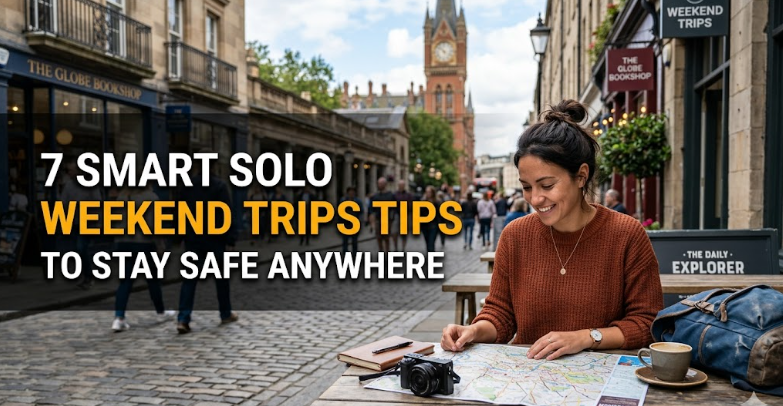
7 Smart Solo Weekend Trips Tips to Stay Safe Anywhere
There’s a particular kind of freedom that only solo travel gives you.
You leave when you want. You eat where you feel like eating. You change plans without consulting anyone. You walk a little slower through unfamiliar streets, linger longer in bookstores, skip the museum, take the train to nowhere in particular, and discover how much easier it is to hear your own thoughts when nobody else is filling the silence.
That freedom is the reason so many people fall in love with solo weekend travel.
It feels light. Manageable. Low stakes. You do not need two weeks off work, a carefully color-coded itinerary, or a friend whose schedule finally aligns with yours. You just need two open days, a small bag, and the willingness to go.
But solo travel also changes the math of responsibility.
When you travel alone, no one is watching your backpack while you buy water. No one notices first if you took the wrong turn. No one checks whether you made it back to your room. No one automatically shares the mental load.
That doesn’t make solo travel dangerous. It makes awareness more important.
The safest solo travelers are rarely the most fearless. They are usually the most observant. They prepare just enough, stay flexible, and make a series of small, smart decisions that prevent avoidable problems before they begin.
A safe solo weekend trip is not built on paranoia. It is built on practical habits.
The good news is that staying safe almost anywhere does not require expensive gear, military-level planning, or constant anxiety. It mostly comes down to simple choices: how you book, what you carry, what you share, what you notice, and when you trust your instincts.
These seven smart tips make solo weekend travel safer, smoother, and far more enjoyable—without making it feel like work.
1. Plan just enough to stay flexible
The biggest solo travel mistake is usually one of two extremes: planning nothing or planning every minute.
Both can create problems.
If you arrive with no plan at all, you’re more likely to make rushed decisions when tired, hungry, or disoriented—exactly when people overspend, end up in poor locations, or miss obvious warning signs.
If you over-plan, you become rigid. And rigid travelers often ignore changing conditions because they’re too attached to the original itinerary.
The sweet spot is structure without overcommitment.
For a solo weekend trip, that means planning only the pieces that matter most:
- where you’re staying
- how you’re getting there
- how you’re getting back
- one or two anchor activities
- a rough understanding of the area
That’s enough.
You do not need an hour-by-hour schedule. You need a framework.
Book your accommodation in advance, especially if you’re arriving late. Know how you’ll get from the station or airport to where you’re staying. Save the return timing before you leave. Pick one main thing you definitely want to do each day, then leave the rest open.
This gives you room to wander without becoming careless.
A loose plan also helps you look less vulnerable. People who stop in the middle of a sidewalk to panic-search directions, scramble for a room at midnight, or visibly realize they have no idea where they are tend to attract the wrong kind of attention.
A traveler with a simple plan moves differently. Even when they’re improvising, they look intentional.
That alone reduces friction.
Before leaving, spend twenty minutes doing the kind of preparation that prevents 80 percent of avoidable stress:
- screenshot your hotel address
- download offline maps
- save train or bus tickets
- note emergency contacts
- identify one nearby pharmacy or clinic
- check local transport hours
- scan neighborhood reviews
That is not overplanning. That is intelligent convenience.
Solo weekend trips work best when the foundation is stable enough to support spontaneity.
Freedom gets better when it has structure underneath it.
2. Choose accommodation for location, not aesthetics
A beautiful room in the wrong area can ruin a solo trip.
This is one of the most common booking mistakes, especially for weekend travelers who are trying to save money or get something “cute” for photos.
A stylish rental means very little if it leaves you isolated, poorly connected, or uncomfortable walking back after dark.
When traveling solo, location is not a luxury. It is part of your safety plan.
The best accommodation for a solo weekend trip is not necessarily the cheapest, trendiest, or most photogenic. It is the one that makes your movement easier and safer.
Prioritize:
- a well-reviewed area
- easy access to transport
- walkability
- active streets in the evening
- reliable check-in
- strong recent reviews from solo travelers
This matters more than décor.
A smaller room in a central, active neighborhood is usually safer than a larger, prettier one in a quiet fringe area that empties after sunset.
Look closely at recent reviews—not just the star rating.
You are looking for clues:
- Did people mention arriving late without issues?
- Did solo travelers say they felt comfortable?
- Was the street active at night?
- Were there complaints about access, broken locks, poor lighting, or unclear check-in?
Read between the lines.
“Quiet and secluded” can be wonderful for couples on retreat. It can be inconvenient and stressful for someone arriving alone on a Saturday night.
“Authentic local area” sometimes means charming and residential. It can also mean badly lit, poorly connected, and difficult to navigate if you do not speak the language.
When in doubt, choose practical over picturesque.
Hotels often make more sense than short-term rentals for quick solo weekends because they usually offer:
- staffed reception
- easier check-in
- luggage storage
- faster help if something goes wrong
- better accountability
That doesn’t mean rentals are unsafe. It means the margin for error is smaller.
If you do book a rental, confirm:
- exact entry instructions
- building access
- backup contact
- neighborhood feel after dark
- mobile signal/Wi-Fi reliability
Your room is not just where you sleep.
It is your base, your reset point, your charging station, and your fallback plan.
Choose accordingly.
3. Travel light, but carry the right things
The lighter you travel, the easier it is to stay aware.
This is one of the least discussed advantages of packing well.
When you are dragging too much stuff, your attention narrows. You become slower, more distracted, less mobile, and easier to overwhelm. You are thinking about managing your belongings instead of noticing your environment.
Solo travel gets safer when your hands and mind stay free.
For a weekend trip, you do not need much.
A small backpack or compact carry-on is usually enough. The goal is not minimalism for its own sake. The goal is mobility.
Pack so that you can:
- carry everything comfortably
- move quickly if needed
- keep valuables organized
- avoid checking luggage
- keep both hands available
That alone makes stations, sidewalks, stairs, and transit much easier to manage.
What you bring matters just as much as how much you bring.
A smart solo weekend kit should include:
- fully charged phone
- power bank
- charging cable
- one backup payment method
- ID and digital copies of documents
- small amount of emergency cash
- any medication you need
- tissues
- hand sanitizer
- refillable water bottle
- simple first-aid basics
- weather-appropriate layer
- small lock or zip clip
- flashlight or phone torch backup
These are not dramatic survival tools. They are friction reducers.
They help when trains run late, batteries die, card readers fail, rain starts, pharmacies close, or you end up walking farther than expected.
Keep your essentials in the same place every time.
This sounds small, but consistency matters when you are tired.
Your card goes in the same pocket. Your passport goes in the same compartment. Your room key goes in the same pouch. Your charger returns to the same zip section.
When everything has a place, you notice faster when something is missing.
That reduces panic and mistakes.
Avoid carrying every valuable with you all day. Bring what you need, leave what you don’t.
And never pack in a way that makes you look visibly overloaded.
The less you have to manage, the more attention you can give to what matters.
In solo travel, that is a real advantage.
4. Share your plans without broadcasting them
One of the smartest things solo travelers can do is stay visible to the right people and invisible to the wrong ones.
That balance matters.
You do not need to announce every move online in real time. In fact, doing that often creates unnecessary exposure.
Posting your exact location while traveling alone, especially publicly, is rarely a good habit.
It tells strangers where you are, where you are not, and sometimes that you are alone.
Share selectively instead.
Before your trip, send one person:
- your destination
- where you’re staying
- rough travel schedule
- return time
- emergency contact details
You do not need a formal safety protocol. You just need one reliable person who roughly knows your movements.
A simple message works:
“Heading to Lahore Saturday morning, staying near Gulberg, train back Sunday evening. I’ll text when I check in.”
That is enough.
Then follow through.
Send short check-ins:
- when you arrive
- when you check in
- if plans change significantly
- when you’re heading back
These are not dramatic safety alerts. They are quiet accountability.
If something goes wrong, the difference between “somebody knows roughly where I am” and “nobody has any idea” matters more than most people realize.
At the same time, be cautious about what you share publicly.
Avoid posting:
- your hotel name in real time
- your room view while still there
- live location tags
- exact solo routines
- public updates that clearly signal you’re alone
Post later.
There is no downside to delayed sharing, and there is often upside.
This also applies offline.
You do not owe strangers your full itinerary.
If someone asks whether you are alone, where you are staying, or what your plans are, answer casually but vaguely.
Keep it polite. Keep it unremarkable.
You can be friendly without being fully available.
That is a useful solo travel skill.
Not secretive. Just private.
5. Trust patterns, not appearances
Most people think safety decisions are about spotting obvious danger.
They usually are not.
In real life, risk rarely arrives looking cinematic. It usually shows up as inconsistency.
Something feels off not because it looks dramatic, but because the pattern doesn’t make sense.
That matters more than appearances.
A person can look polished and still be unsafe.
A place can look ordinary and still be wrong.
A street can look rough but be completely fine.
A smiling stranger can be intrusive.
A messy café can be the safest room on the block.
This is why solo safety depends less on aesthetics and more on pattern recognition.
Pay attention to behavioral cues:
- Is someone ignoring normal social boundaries?
- Are they too interested in where you’re staying?
- Are they creating urgency where none exists?
- Are they pushing familiarity too quickly?
- Are they trying to isolate you from public space?
- Are they making you explain your “no” more than once?
That matters.
Many avoidable travel problems begin with social pressure, not obvious threat.
Someone insists on helping when you did not ask.
Someone keeps redirecting you.
Someone is overly invested in changing your plan.
Someone wants you to move somewhere “better,” “quieter,” or “easier.”
Someone keeps talking after you’ve clearly disengaged.
That does not automatically mean danger.
It does mean pay attention.
The safest solo travelers do not overreact to everything. They simply notice patterns early and respond before discomfort becomes risk.
This can be as simple as:
- stepping into a busier place
- changing direction
- ending a conversation
- declining firmly
- getting back into public view
- leaving sooner than planned
You do not need proof to remove yourself from a situation that feels wrong.
You need enough information to decide discomfort is not worth testing.
That is not paranoia.
That is discernment.
6. Move like you belong, even when you don’t
Confidence is not about pretending to know everything.
It is about reducing visible uncertainty.
People who look lost are not automatically unsafe, but visible confusion can make you easier to approach, mislead, pressure, or distract.
The goal is not performance. It is composure.
You do not need to act like a local. You just need to avoid broadcasting disorientation.
That starts with small habits.
If you need directions, do not stop in the middle of the pavement with your luggage open and your phone in both hands.
Step aside. Enter a shop. Stand near a wall. Check your route there.
Pause with intention.
If you need to reorient, do it from a place that gives you time and cover.
The same applies when using your phone in unfamiliar areas. Avoid walking while fully absorbed in it. Look first, then check.
Move in short confident bursts.
Walk. Pause. Recheck. Continue.
That looks more deliberate and keeps you more aware.
When possible:
- arrive before dark in unfamiliar places
- identify landmarks as you move
- note entrances and exits
- keep your phone usable but not constantly exposed
- avoid advertising valuables
- keep your pace steady and purposeful
You do not need to rush. You need to look like you have somewhere to be.
This also helps socially.
People are less likely to test boundaries when you appear self-contained and decisive.
You do not need to be cold. You need to be clear.
Polite confidence prevents more problems than visible niceness ever will.
Solo travelers often worry about seeming rude.
But clarity is not rudeness.
“No thanks.”
“I’m fine.”
“I’ve got it.”
“I’m meeting someone.”
“Not today.”
Short. Calm. Finished.
No apology required.

7. Build a personal safety rhythm
The safest solo travelers usually do not rely on one big precaution.
They rely on rhythm.
A repeatable set of small habits makes travel safer because it reduces decision fatigue. You stop improvising basic safety every hour and start running simple checks automatically.
That rhythm becomes your system.
And systems are what hold up when you’re tired.
Your personal travel rhythm might look like this:
Before leaving your room:
- phone charged
- power bank packed
- route checked
- essentials accounted for
- accommodation card/screenshots saved
When arriving somewhere new:
- scan exits
- note atmosphere
- identify transport back
- assess whether you’d return here after dark
Before sunset:
- decide whether you’re staying, rerouting, or heading back
Before getting into transport:
- confirm route
- verify plate or driver
- share trip if needed
At night:
- simplify
- reduce unnecessary detours
- choose convenience over adventure
None of this is dramatic.
That is the point.
Safe solo travel is usually built on ordinary habits repeated consistently.
Not fear.
Not hypervigilance.
Not suspicion of everything.
Just rhythm.
You create small defaults that make good decisions easier when energy is lower and conditions change.
That is what experienced solo travelers actually do.
They do not eliminate risk.
They reduce avoidable risk through habit.
And that is what makes solo weekend travel feel less stressful and more enjoyable.
The real goal is not to travel fearlessly
The goal is to travel well.
There is a difference.
Fearlessness is overrated. It often gets confused with denial, performance, or unnecessary risk tolerance.
What actually makes solo travel enjoyable is not the absence of concern. It is the presence of competence.
You know how to prepare.
You know how to notice.
You know how to leave.
You know how to adapt.
You know how to keep moving without becoming careless.
That is what confidence really is.
Solo weekend trips do not need to be complicated to be memorable.
Some of the best ones are simple: one train, one small bag, one booked room, one neighborhood you’ve never seen before, and enough awareness to enjoy being there fully.
Go somewhere.
Stay curious.
Pay attention.
Make good small decisions.
Let the trip be easy.
That is usually where the best solo travel stories begin.
FAQs
Is solo weekend travel safe for beginners?
Yes, solo weekend travel is often one of the safest ways to begin traveling alone because the time frame is short, the logistics are simpler, and it is easier to stay organized. A weekend trip lets you build confidence without committing to a longer journey. Start with a destination that is easy to navigate, well-connected, and comfortable for first-time solo travel.
What is the safest type of accommodation for solo travelers?
For most solo weekend travelers, centrally located hotels with staffed reception are often the safest and most convenient option. They usually offer easier check-in, more support, better accountability, and simpler logistics than isolated rentals. The best choice is usually the one in a well-reviewed, walkable area with reliable access to transport.
Should I tell people I’m traveling alone?
Only selectively. It is smart to tell one trusted person your general plans, where you are staying, and when you expect to return. But there is no need to share detailed solo travel information with strangers or post your exact location publicly in real time. Stay visible to the right people and private with everyone else.
What should I do if I feel unsafe while traveling alone?
Leave early and move toward visibility. Go somewhere public, well-lit, and populated—a café, hotel lobby, shop, or transport hub. You do not need to justify leaving a place or conversation that feels wrong. Trust the pattern, remove yourself, and reassess once you are in a more comfortable environment.
How do I avoid looking like a vulnerable tourist?
The easiest way is to reduce visible confusion. Check directions before moving, pause inside shops instead of in the middle of the street, avoid fumbling with bags, and move with steady intent. You do not need to look local. You only need to look composed, aware, and difficult to pressure.
What is the biggest solo travel safety mistake?
Oversharing and underplanning. Many solo travelers either reveal too much in real time—online or offline—or travel with no basic structure at all. The safest approach is simple: plan the essentials, stay flexible, share selectively, and keep enough awareness to adapt quickly.