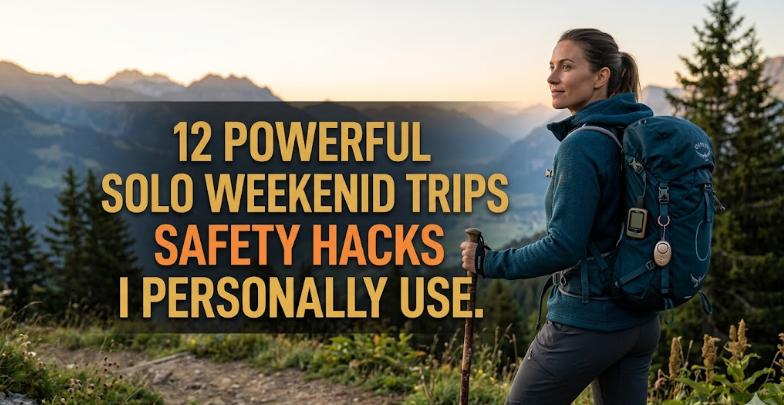
12 Powerful Solo Weekend Trips Safety Hacks I Personally Use
There’s a particular kind of freedom that only shows up when you leave town alone on a Friday and come back on Sunday with a clearer head, a lighter bag, and a sharper instinct for yourself.
Solo weekend trips are one of the easiest ways to reset without rearranging your entire life. You don’t need a two-week itinerary, a big budget, or a dramatic reason to disappear for a while. You just need a backpack, a plan loose enough to breathe, and a safety system strong enough to let you enjoy the trip instead of managing low-grade anxiety the whole time.
That’s the part people don’t talk about enough.
Most solo travel advice tends to swing between two extremes. One side treats every destination like a threat map. The other romanticizes solo travel so much that it ignores the practical reality of being alone in unfamiliar places. Neither is especially useful when what you actually need is a calm, repeatable way to travel alone and feel in control.
I don’t travel solo like I’m preparing for disaster. I travel solo like someone who wants fewer avoidable problems.
That’s the difference.
Over time, I’ve built a small set of safety habits that make solo weekend trips feel easier, smoother, and far less mentally expensive. These are not dramatic survival tactics. They’re not fear-based rituals. They’re practical systems that reduce friction, limit exposure to obvious risks, and preserve your energy for the part of the trip you actually came for.
These are the 12 safety hacks I personally use every time I take a solo weekend trip.
1. I never book the absolute cheapest place anymore
I used to think budget solo travel meant squeezing accommodation costs as low as possible.
Now I think of accommodation as the first layer of security.
The cheapest room in town often costs more in stress than it saves in money. That price gap usually gets paid back in bad lighting, poor location, weak locks, thin staffing, sketchy entrances, or the kind of property where nobody notices who comes and goes.
When I travel alone, I’m not paying only for a bed. I’m paying for friction reduction.
That means I care less about whether a place has aesthetic decor and more about whether it has:
- recent reviews
- consistent mentions of cleanliness
- secure entry
- staffed reception or responsive hosts
- a well-lit entrance
- easy access to transport
- a location that doesn’t force me into isolated streets after dark
I’ll take a smaller room in a better area over a bigger room in a cheaper one every time.
That single decision solves more safety problems than most gadgets ever will.
A good stay reduces the number of judgment calls you have to make while tired. That matters more than people realize.
2. I build a “low-decision arrival” plan before I leave
Most solo travel mistakes happen in transition moments.
Not during the scenic parts.
Not during the fun parts.
They happen when you’re arriving tired, slightly distracted, carrying your bag, checking directions, scanning signs, and trying to figure out what happens next.
That’s when people overshare, get disoriented, miss obvious red flags, or make fast decisions they wouldn’t normally make.
So I remove as many arrival decisions as possible before I leave home.
Before every trip, I already know:
- how I’m getting from station or airport to where I’m staying
- what my backup route is
- what the neighborhood looks like
- where the nearest convenience store is
- whether I can check in late
- what I’ll do if my phone battery drops
- where I can wait safely if I arrive early
I don’t like improvising while tired in unfamiliar places. I like improvising once I’m settled.
There’s a huge difference.
A low-decision arrival keeps the first hour calm, and that first hour shapes the entire tone of a solo trip.

3. I send one simple location message to one trusted person
I don’t do elaborate “live updates” when I travel solo.
I don’t want to narrate my entire weekend in real time, and I definitely don’t want multiple people tracking me like I’m on a field operation.
What I do want is one clean safety line.
Before I leave, one trusted person gets:
- where I’m going
- where I’m staying
- when I expect to arrive
- when I expect to return
- one check-in window
That’s it.
Simple works better because simple gets used.
Overcomplicated safety systems fail the moment they become annoying. If your plan requires constant updates, eventually you’ll stop doing it. A single reliable check-in is more useful than an ambitious communication plan you abandon halfway through Saturday.
My rule is straightforward: one person should know where I’m supposed to be, and roughly when.
That’s enough to create accountability without turning the trip into admin.
4. I avoid broadcasting that I’m alone in real time
This is one of the easiest habits to build and one of the most useful.
When I’m traveling solo, I do not advertise that I’m alone to strangers, and I do not post my location in real time.
That includes:
- posting stories while I’m still there
- tagging exact locations immediately
- telling strangers I’m traveling solo for the weekend
- casually announcing I “just got in”
- volunteering that nobody knows me in town
None of this is paranoia. It’s just unnecessary exposure.
Most people are harmless. That’s true.
But solo safety gets stronger when fewer strangers know your logistics.
If someone asks, I’m rarely “here alone.” My phrasing is usually vague and boring:
- “I’m meeting friends later.”
- “I’ve got people nearby.”
- “I’m just out for a bit.”
- “I’ve got plans.”
Neutral answers protect your privacy without escalating anything.
The goal is not to act suspicious.
The goal is to stay unremarkable.
That’s usually safer.
5. I use the first-night rule: no unnecessary wandering after dark
I love walking in new places. That’s half the point of going.
But my first night rule is firm: on night one, I do not wander aimlessly after dark just because the city feels exciting.
Night one is when I know the least.
I haven’t calibrated the area.
I don’t know the rhythm of the streets.
I don’t know what empties out early.
I don’t know what “close by” actually feels like on foot.
That first evening is for staying local, eating nearby, observing the pace, and learning the terrain.
I’ll do a short loop.
I’ll clock lighting.
I’ll note open businesses.
I’ll check foot traffic.
I’ll get a feel for what changes after sunset.
That small restraint pays off fast.
A lot of solo travel safety is just delaying unnecessary confidence until it’s earned.
6. I keep my phone alive like it’s part of the itinerary
A dead phone while traveling alone turns small inconveniences into larger problems fast.
It’s not just about maps.
Your phone is navigation, booking access, emergency contact, payment backup, transport, translation, and basic orientation. If it dies, your margin shrinks immediately.
So I treat battery like infrastructure.
I do three things every trip:
- leave with a fully charged power bank
- carry one charging cable I know works
- top up whenever I stop, not when I’m desperate
That last habit matters most.
People wait too long to charge. Then they’re at 8%, outside, unfamiliar, and suddenly making worse decisions faster.
I charge early because I like options.
I also screenshot the essentials:
- hotel address
- booking confirmation
- return ticket
- offline map area
That way, even if signal gets weird, I’m not stranded behind one dead app.
7. I split cash, cards, and ID on purpose
I never keep everything important in one place.
Not because I expect to be robbed.
Because losing one thing shouldn’t become losing everything.
This is one of the most useful low-effort habits I’ve ever built.
I split essentials like this:
- primary card in wallet
- backup card separate from wallet
- small emergency cash hidden elsewhere
- ID stored securely, not flashed constantly
- digital copies stored privately
So if my wallet disappears, the trip is inconvenient, not ruined.
That’s the standard I’m aiming for.
Total loss is what creates panic. Partial loss is manageable.
Solo safety improves dramatically when one mistake doesn’t trigger five more.
8. I trust patterns, not isolated impressions
One of the easiest ways to override your instincts is to dismiss discomfort because nothing “technically wrong” has happened yet.
I’ve learned to stop doing that.
When I’m somewhere unfamiliar, I pay attention to patterns.
Not one strange moment.
Patterns.
One odd person is nothing.
Three small things in ten minutes is information.
That might look like:
- being watched too closely
- repeated attempts to engage
- a street that empties too fast
- a ride situation that feels off
- a host who’s suddenly vague
- an area that changes tone quickly
Most bad situations announce themselves quietly first.
Not dramatically.
Subtly.
The trick is not to argue yourself out of noticing.
You do not need courtroom evidence to leave a situation that feels wrong.
You need enough information to decide your comfort is worth protecting.
That threshold should be lower when you’re alone.
9. I arrive with one “boring safety purchase” in mind
Every destination has one practical thing worth buying immediately.
Usually something small. Usually something unglamorous. Usually extremely useful.
On most solo weekend trips, I buy one boring thing early:
- a bottle of water
- tissues
- local transit card
- simple snack
- cheap pen
- small cash change
- pharmacy basics
It sounds minor. It isn’t.
That first practical purchase does three things:
- it helps me orient
- it reduces future inconvenience
- it gives me an immediate “local normal” interaction
Small transactions are useful calibration.
You learn pace, tone, payment flow, and how the area feels when nothing is at stake.
That’s valuable information early.
10. I don’t prioritize politeness over extraction
This is one of the most important solo safety rules I use, especially in unfamiliar settings.
If something feels off, I leave early.
I leave awkwardly.
I leave without overexplaining.
I do not stay in uncomfortable situations to preserve social smoothness.
That applies to:
- conversations
- rides
- bars
- tours
- shared spaces
- overfriendly strangers
- hosts who push boundaries
A surprising number of unsafe situations persist because someone feels obligated to be polite longer than they feel safe.
I’d rather be briefly rude than slowly cornered.
You do not owe extended access to anyone because they were initially friendly.
Exit early.
Explain less.
Correct later if needed.

11. I keep my weekends “lightly structured,” not fully open-ended
Overly rigid itineraries create stress.
Completely unstructured solo weekends create unnecessary exposure.
I’ve found the safest middle ground is lightly structured freedom.
I usually anchor the day with two fixed points:
- one place I’m definitely going
- one time I’m definitely done
Everything else can flex.
That gives me room to explore without drifting too far, too late, too aimlessly, or too tired.
Too much unstructured wandering creates avoidable decision fatigue. Decision fatigue creates sloppy judgment. Sloppy judgment creates problems that were easy to avoid three hours earlier.
A little structure preserves energy.
Energy preserves judgment.
Judgment preserves safety.
12. I leave before the trip starts going downhill
This is the least glamorous safety habit I have and probably the most useful.
I do not force a solo trip past the point where I’m clearly tired, depleted, overstimulated, underfed, or mentally done.
A lot of avoidable solo travel mistakes happen in the final stretch, when people are too tired to assess well but still trying to squeeze more out of the trip.
That’s when bags get left behind.
That’s when wrong turns happen.
That’s when people accept bad transport options.
That’s when minor problems become expensive ones.
I leave earlier than my optimism wants to.
Not dramatically early.
Just intelligently early.
I’d rather end a solo weekend thinking I could’ve done one more thing than end it exhausted and cleaning up preventable mistakes on Monday.
That margin matters.
The real point of solo travel safety
The best solo travel safety habits are rarely dramatic.
They are quiet.
They are repeatable.
They remove avoidable friction.
They reduce the number of bad decisions available to you when you’re tired, distracted, hungry, rushed, overstimulated, or trying too hard to be easygoing.
That’s what most solo travel safety actually is.
Not fear.
Not hypervigilance.
Not assuming the worst.
Just cleaner systems.
The point is not to travel nervously.
The point is to travel with enough structure that you can relax properly once you’re there.
That’s the real reward.
Good solo travel safety habits do not make travel feel smaller.
They make freedom feel sturdier.
And that’s what makes a weekend away actually restorative.
Not just getting out of town.
But being able to enjoy leaving it.
FAQs
Is solo weekend travel actually safe?
Yes, in most places it can be very safe when approached with basic planning and situational awareness. Solo travel becomes riskier when people rely too heavily on spontaneity during vulnerable moments like late arrivals, low battery, poor sleep, or unfamiliar transport decisions. Most safety issues are preventable with better systems, not better luck.
What is the safest type of accommodation for solo weekend trips?
The safest option is usually a well-reviewed hotel, guesthouse, or short-stay property in a central, well-lit area with consistent recent reviews and secure entry. The goal is not luxury. The goal is predictability, visibility, and fewer avoidable judgment calls when arriving tired or returning late.
Should I tell people I’m traveling alone?
Not casually, and not in ways that make your logistics obvious. You do not need to lie dramatically, but it helps to stay vague with strangers. Avoid oversharing where you’re staying, how long you’re in town, or the fact that nobody is expecting you nearby.
How often should I check in with someone during a solo trip?
Usually once is enough for a short weekend trip. Share your destination, accommodation, expected arrival, and one check-in window with one trusted person. The best check-in system is the one you’ll actually use consistently.
What should I always carry on a solo weekend trip?
At minimum: a charged phone, power bank, backup payment method, small emergency cash, ID, water, and one offline version of your essential bookings or directions. The goal is not to carry more. It is to avoid one small failure turning into a larger problem.
What’s the biggest solo travel safety mistake people make?
The most common mistake is ignoring friction early and trying to “be chill” through obvious discomfort. Most bad situations do not begin dramatically. They begin as subtle inconvenience, low-grade discomfort, repeated odd behavior, or the feeling that something is slightly off. The safest move is often the earliest one.