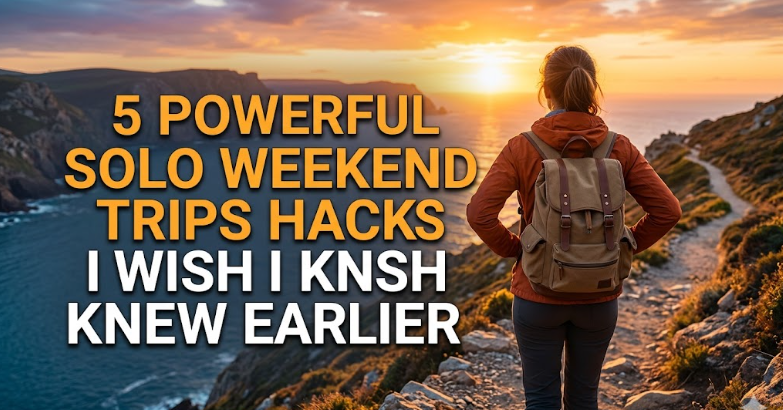
5 Powerful Solo Weekend Trips Hacks I Wish I Knew Earlier
There’s something quietly transformative about leaving your everyday life behind for just a couple of days. No grand itinerary. No group chats. No compromises. Just you, a bag, and a weekend that stretches wider than it looks on a calendar.
But here’s the part no one really tells you: solo weekend trips can either feel like a luxurious escape or a stressful scramble—and the difference often comes down to a handful of small, practical decisions.
I learned this the hard way.
My early solo trips were full of tiny mistakes that snowballed—overpacking, overspending, under-planning, or worse, planning too much. I’d return home more tired than when I left, wondering why something that looked so effortless on social media felt so chaotic in real life.
Over time, though, patterns emerged. Little adjustments turned into habits, and those habits turned into hacks I now swear by. These aren’t flashy travel secrets. They’re simple shifts in thinking that quietly upgrade your entire experience.
Here are five powerful solo weekend trip hacks I wish I had known earlier—each one earned through trial, error, and a few missed trains.
—
hack 1: treat time as your main currency, not money
Most people approach weekend trips with a budget-first mindset. Flights, accommodation, food—it all gets calculated down to the smallest detail. And while that’s important, it’s not the real constraint.
Time is.
A weekend trip is brutally short. You’re working with maybe 48–60 usable hours, and every decision either protects or wastes that time.
I once booked a cheaper bus instead of a slightly more expensive train. The bus took four extra hours. That decision didn’t just cost me time—it cost me a sunset I had planned to see, a relaxed dinner, and a good night’s sleep. I saved a small amount of money and lost a large chunk of the experience.
That’s when the shift happened.
Now, I evaluate every decision through a simple question: does this save or cost time?
Sometimes spending a little more means:
– arriving early enough to explore instead of just settling in
– choosing accommodation closer to the center instead of commuting
– booking direct transport instead of dealing with connections
It’s not about being extravagant. It’s about being intentional.
When you start valuing time properly, your trips begin to feel longer, fuller, and surprisingly more relaxed—even if they cost slightly more.
Try this the next time you plan a trip: assign a “time value” to each decision. If something saves you two hours, ask yourself what those two hours are worth to you in experience, energy, or peace of mind.
You might be surprised by your answer.
—
hack 2: pack for flexibility, not perfection
If there’s one thing that sabotages solo weekend trips faster than anything else, it’s overpacking.
I used to pack “just in case” outfits, extra shoes, backup toiletries, and items I never ended up touching. My bag would be heavy, my movement restricted, and my energy drained before the trip even properly began.
The truth is, weekend trips don’t need perfect preparation—they need flexible preparation.
Instead of packing for every possible scenario, pack for combinations.
A simple strategy that changed everything for me:
– choose a neutral color palette so everything matches
– bring one versatile layer instead of multiple bulky ones
– pick shoes that work for both walking and casual outings
– limit yourself to essentials you know you’ll use
There’s a quiet freedom in carrying less. You move faster, you worry less, and you adapt more easily.
On one trip, I packed so light that I skipped baggage lines entirely, walked straight out of the station, and started exploring within minutes. That moment alone made me rethink everything I thought I needed.
Packing light isn’t about minimalism for its own sake. It’s about removing friction.
When your bag stops being a burden, your trip starts feeling like an experience instead of a task.
—
hack 3: design your first 3 hours carefully
The beginning of a solo trip sets the tone for everything that follows.
And yet, most people leave it completely unplanned.
They arrive, feel slightly disoriented, maybe tired from travel, and then waste precious time deciding what to do next. That uncertainty can quietly drain excitement and replace it with hesitation.
I’ve been there—standing outside a station, scrolling through options, feeling like I’ve already lost momentum.
Now I do something simple but incredibly effective: I design my first three hours before I even leave home.
Not a rigid schedule. Just a loose sequence.
For example:
– know exactly how you’ll get from arrival point to accommodation
– have one easy food option in mind nearby
– pick one low-effort activity (a walk, a café, a viewpoint)
That’s it.
This small structure eliminates decision fatigue at the most vulnerable point of your trip.
On one weekend, I landed early morning, followed my pre-planned route, had breakfast at a quiet local spot, and took a short walk through a nearby park. By the time most people were still figuring out their plans, I already felt settled, energized, and fully present.
The rest of the trip flowed naturally from there.
Those first few hours aren’t just logistical—they’re emotional. They determine whether you feel confident and excited, or scattered and unsure.
Treat them with care.
—
hack 4: embrace “one main thing” per day
Here’s a trap many solo travelers fall into: trying to do too much.
It’s understandable. You’ve traveled somewhere new, time is limited, and you want to make the most of it. So you pack your itinerary with activities, attractions, and must-see spots.
The result?
Exhaustion.
What I’ve learned is this: a great weekend trip doesn’t come from doing everything—it comes from doing a few things well.
Now I follow a simple rule: one main thing per day.
That could be:
– exploring a historic area
– hiking a scenic trail
– visiting a museum or cultural site
– spending a few hours by the water
Everything else becomes optional.
This approach creates space—space to wander, to pause, to notice small details that often get lost in rushed itineraries.
On one trip, my “one main thing” was simply walking through an old town area. That was it. No checklist. No pressure.
What happened was unexpected.
I found a quiet bookstore, had an unplanned conversation with a shop owner, and discovered a hidden café that became the highlight of the entire weekend.
None of that would have happened if I had been rushing from one scheduled activity to another.
When you reduce pressure, you increase presence.
And presence is where the real experience lives.
—
hack 5: build a “return buffer” into your plan
This is the hack I ignored the longest—and paid for repeatedly.
Returning from a weekend trip often feels rushed. You squeeze in one last activity, cut things close with transport, and arrive home tired, sometimes stressed, with no time to reset before jumping back into routine.
It turns the end of your trip into a scramble.
Now I plan my return with intention.
I create what I call a “return buffer.”
This means:
– choosing a slightly earlier departure than necessary
– avoiding last-minute activities before leaving
– allowing time for unexpected delays
– giving yourself breathing room before re-entering daily life
At first, it feels like you’re cutting your trip short.
But in reality, you’re protecting the quality of your ending.
There’s something deeply satisfying about a calm, unhurried return. You reflect more, you carry the experience with you longer, and you transition back into routine without that jarring feeling.
One Sunday, instead of rushing, I sat at a quiet café near the station, reviewed photos, wrote a few notes about the trip, and simply let the experience settle.
That hour did more for my memory of the trip than any extra activity could have.
A good ending doesn’t just conclude your trip—it completes it.
—
bringing it all together
These five hacks aren’t complicated. They don’t require special tools, expensive upgrades, or insider knowledge.
They’re shifts in perspective.
Value time over small savings.
Pack with intention instead of fear.
Start strong with a clear first few hours.
Focus on depth instead of quantity.
End gently instead of abruptly.
Individually, each one improves your trip slightly. Together, they transform it.
Solo weekend trips stop feeling rushed and start feeling rich—not in money, but in experience.
And perhaps the most surprising part?
Once you travel this way, it becomes difficult to go back.
—
a short reflection exercise (try this before your next trip)
Before your next solo weekend trip, take five minutes and write down:
– what do you actually want to feel during this trip?
– what usually drains your energy when you travel?
– which of these five hacks would solve that problem?
This small exercise helps you personalize these ideas instead of just reading them.
Travel isn’t just about movement. It’s about awareness.
And awareness is what turns a simple weekend into something that stays with you.
—
frequently asked questions
- how far should I travel for a weekend trip?
Ideally, choose a destination that takes no more than 4–6 hours to reach. Anything longer eats into your limited time and can make the trip feel rushed rather than refreshing.
- is solo travel safe for short trips?
In most cases, yes—if you follow basic precautions. Share your itinerary with someone you trust, stay in well-reviewed accommodations, and remain aware of your surroundings. Short trips are often safer because they require less complex planning.
- how do I avoid feeling lonely while traveling alone?
Plan small interactions into your day—visit cafés, join short tours, or simply spend time in public spaces. Loneliness often comes from isolation, not solitude. There’s a difference, and you can manage it.
- what’s the ideal budget for a solo weekend trip?
It varies depending on location, but a good approach is to prioritize spending on time-saving elements like transport and location, while keeping food and activities flexible. It’s less about a fixed number and more about smart allocation.
- should I plan everything in advance?
No. Plan the essentials—transport, accommodation, and your first few hours. Leave the rest open. Overplanning can reduce spontaneity, which is one of the best parts of solo travel.
- how can I make my trip feel more meaningful?
Slow down. Choose fewer activities, stay present, and reflect on your experiences. Even small moments—like a quiet walk or a good meal—can become meaningful if you give them your full attention.
—
In the end, solo weekend trips aren’t about escaping your life. They’re about reconnecting with it—from a slightly different angle.
And sometimes, that’s all you need.