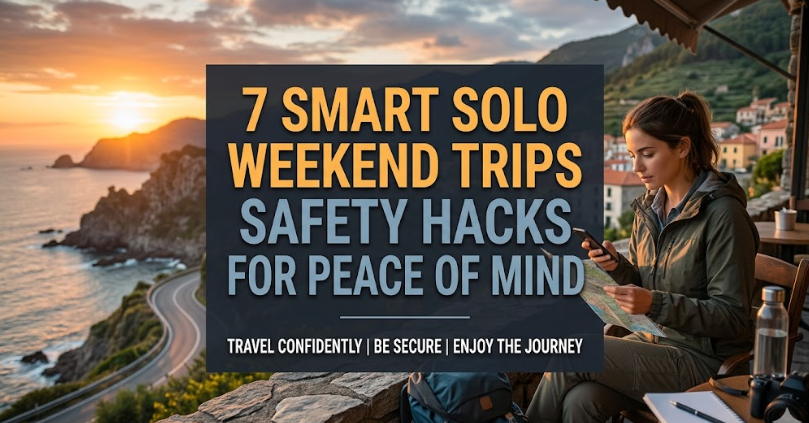
7 Tips For The Solo Weekend Traveler To Stay Safe
Meta Description: Solo weekend trips safety hacks for every solo traveler — 7 brilliant, evidence-based strategies to keep safe, confident, and worry-free on your next solo adventure.
Solo travel is one of the most rewarding things you can do. You set the pace. You pick the destination. You answer to no one.
But here’s the truth — going it alone means you’re your own safety net, too.
Whether you’re a solo weekend-warrior novice or a lifelong lone wolf on the road, safety should always be part of your itinerary. Not the kind that makes you afraid to leave home — the kind that makes you feel truly confident to go further, check out more, and enjoy every minute without a nagging “what if” in the back of your head.
In this guide, we’ll go through 7 smart solo weekend trips safety hacks that are practical and easy to implement. No fear-mongering. No fluff. Only simple, actionable steps you can use immediately.
How Solo Travelers Can Build a Strong Safety Plan
When you travel with a group, safety is in numbers. If you wander off, someone notices. If things go sideways, someone is there.
When you go solo, that safety net disappears.
That doesn’t make solo travel dangerous, though. Millions do it every year without incident. But it does mean you have to be a little more intentional. A handful of simple habits — most of which can be set up in under 20 minutes — will dramatically lower your risk and keep you far more relaxed.
Here’s how to do it right.
Hack 1 — Send the Itinerary Before You Go
This is the single most important thing any solo traveler can do, and it costs you nothing.
Send your full travel itinerary to at least two trusted people before you head out. That means your hotel name, address, booking confirmation number, and an approximate location for each day.
Set Up a Check-In System
A shared itinerary does little without follow-up. Establish a time each day to check in with your contact — something like “I’ll text you by 9 PM every night.” If they don’t hear from you, a red flag goes up.
It doesn’t need to be complicated. An “All good, at the hotel” message is perfectly fine.
You can also enable the Share My Location feature on Google Maps, which allows a trusted person to see your real-time location. It runs in the background and doesn’t consume much battery.
What to Include in Your Itinerary
| Detail | Why It Matters |
|---|---|
| Hotel name and address | So someone can call or show up if necessary |
| Check-in and check-out dates | Helps establish a timeline in an emergency |
| Flight or train numbers | Makes it easy to track your movements |
| Tour or activity bookings | Tells them when and where you’ll be |
| Local emergency number | So your contact can reach local help |
Keep it simple. A note in your phone’s notes app that you forward to someone works perfectly fine.

Hack 2 — Create Your Digital Backup Kit
Imagine this: you arrive at your destination and someone steals your bag. Passport, wallet, phone — gone. What do you do next?
If your answer is mostly panic and little action, it’s time to build a digital backup kit.
What Goes in the Kit
Scan or photograph the following and store them in a cloud service like Google Drive or Dropbox:
- Passport photo page
- Driver’s license or national ID
- Insurance policy (including claim phone number)
- Vaccination records if required
- Hotel booking confirmation
- Flight or train booking confirmation
Send copies to yourself and to one trusted contact at home. That way, even if your phone dies, you can log in from any device anywhere in the world and access what you need.
The Offline Piece
Cloud access is great, but signal isn’t always guaranteed. Take screenshots of your key bookings and save them offline on your device before you travel. Do the same for your accommodation address — you want to be able to show a driver where you need to go even without internet.
Hack 3 — Act Like a Local
Dressing like a tourist gets you targeted. Not always, not everywhere — but often enough that blending in is a worthwhile pursuit.
That doesn’t mean pretending to be a local. It just means avoiding the signals that say “I’m new here, I’m carrying valuables, and I’m not sure where I’m going.”
The Big Three to Avoid
First, leave the flashy stuff at home. Expensive cameras, showy jewelry, and high-end branded bags are magnets in crowded tourist areas.
Second, research local dress norms before you pack. In some cities, shorts and sandals are perfectly fine. In others, they immediately mark you as an outsider. A quick Google search takes two minutes and can save you a lot of unwanted attention.
Third, avoid roaming charges and get a local SIM or eSIM before you go. Roaming costs are painful, but more importantly, squinting at your phone in frustration is noticeable. A local data plan helps you move with more confidence.
Smart Bag Choices
Backpacks look casual, but they can easily be unzipped from behind. A small crossbody bag worn at the front of your body is much harder to access without your knowledge — and even if someone gets close, reaching for the zipper becomes obvious. Keep it zipped, keep it tight to your body, and carry only what you need for the day.
Hack 4 — Research Your Accommodations
Not all places to stay are alike. And when you’re solo, the quality of your lodging matters more than it would if you had friends along.
What to Look for When Booking
Seek out reviews from solo travelers. Sites like HostelWorld, Booking.com, and TripAdvisor all have options to filter by traveler type. If other solo travelers mention flimsy locks, inattentive staff, or a sketchy neighborhood after dark — believe them.
Look for a property with 24-hour front desk access. This matters more than the breakfast buffet. At 2 AM, you want a real person who can help — not a machine.
On Arrival — A Quick Room Audit
Before you unpack, run through this brief check:
- Test the door lock. Does it feel solid? Does the deadbolt actually work?
- Check window latches, particularly if you’re on a lower floor.
- Note the nearest emergency exit.
If something feels wrong, request a different room. You’re a paying guest. It’s a perfectly reasonable ask.
Hack 5 — Move Around Safely
A large part of solo traveler safety comes down to getting from A to B. Airports, train stations, late-night rides — these are the moments when you need to stay sharp.
Ground Transport Rules
Stick to official taxis or verified ride-hailing apps. In a new city, it’s easy to be approached at the airport by someone offering a “great deal” on a ride. Don’t take it. Use Uber, Lyft, Bolt, Grab, or whatever the local app is.
When getting into a ride-hailing car, share your trip details with a contact. Most apps have a built-in “share my trip” feature. Use it every time — not just when you feel uneasy.
Sit behind the driver. It gives you access to both rear doors and is the easiest exit seat if you need to leave quickly.
Night Travel Tips
- Avoid deserted bus stops or train platforms late at night.
- Walk in well-lit, populated areas.
- Know your route in advance — don’t drift around staring at your phone in unfamiliar places.
- Trust your instincts. If a street feels wrong, take a longer route that feels safer.
As soon as you arrive at your destination, save the local emergency number in your phone contacts. In Europe it’s 112. In the US it’s 911. Every country has one — know it before you need it.
Hack 6 — Pack for Emergencies, Not Just Comfort
Most people pack based on weather and wardrobe. Smart solo travelers also pack for things going wrong.
Your Solo Travel Emergency Kit
You don’t need a suitcase-sized first-aid kit. A small ziplock bag with the essentials is enough:
- Band-aids and antiseptic wipes
- All prescription medications — bring more than you think you’ll need
- Over-the-counter pain relief and anti-diarrhea tablets
- A compact portable charger
Beyond the physical kit, stash $50–$100 in cash somewhere separate from your main wallet. If your wallet gets stolen, your card gets frozen, or the ATM is down, that cash is your lifeline.
Know Your Nearest Hospital
Before leaving your accommodation each day, spend 30 seconds looking up the nearest hospital or urgent care facility to wherever you’ll be. Save the address. You may never need it — but if you do, you’ll be glad it’s already in your phone.
A Note on Travel Insurance
This deserves its own mention. Travel insurance for a solo weekend trip is not expensive. It covers medical emergencies, cancellations, lost luggage, and more. When something goes wrong, the cost of not having it far exceeds the premium. Get it every time.
Hack 7 — Trust Your Gut (It’s Almost Always Right)
No amount of planning can replace the most effective safety tool you have: your instincts.
Humans are hardwired to sense danger. When something feels off — a situation, a person, a neighborhood, a conversation — your body is picking up on signals your conscious mind hasn’t yet registered. A tightening in your chest. An urge to leave. An unexplainable unease.
Listen to it.
Turning Instinct Into Action
You don’t owe anyone a reason to leave a situation. If a conversation makes you uncomfortable, end it. If somewhere feels sketchy, leave. If a ride doesn’t feel right, cancel it and wait for another.
A useful trick: pre-type an escape text. Something like: “Call me now, it’s urgent.” If you’re in a situation where you don’t feel safe but can’t say so openly, send it to someone trusted. They’ll know to call you — giving you a natural reason to walk away.
How Solo Travel Communities Can Help
Before heading anywhere, spend 10 minutes on a solo travel forum or subreddit for that destination. Real travelers share up-to-date, hyperlocal safety tips that no guidebook can match. Communities like r/solotravel on Reddit are full of people who’ve been where you’re going and want to help.
Knowing which neighborhoods to avoid at night or which taxi stands are notorious for overcharging can completely change how you navigate a new place.
Solo Weekend Trips Safety Checklist
Screenshot or print this before your next trip:
| Task | When to Do It | Done? |
|---|---|---|
| Send itinerary to two contacts | 24 hours before departure | ☐ |
| Upload documents to cloud storage | 24 hours before departure | ☐ |
| Screenshot offline bookings | Night before | ☐ |
| Pack emergency cash separately | Night before | ☐ |
| Save local emergency number | On arrival | ☐ |
| Check locks and exits in room | On arrival | ☐ |
| Look up nearest hospital | Each morning | ☐ |
| Set daily check-in time with contact | Before leaving home | ☐ |
| Turn on location sharing | Before leaving home | ☐ |
| Research solo travel forums for destination | Before leaving home | ☐ |
FAQs About Solo Weekend Trip Safety
Q: Is it really safe to travel alone? Yes, for the vast majority of people. Millions of solo trips happen every year without incident. The key is preparation. Implementing even a few of the hacks in this guide puts you in a substantially better position than most travelers.
Q: What is the most critical safety measure for solo travel? Letting a trusted contact know your itinerary and setting up a daily check-in system. If something goes wrong, having someone who knows where you are and when they should hear from you is the fastest way to get help.
Q: Do I really need travel insurance for a short weekend trip? Yes. Medical emergencies don’t care how long your trip is. In some countries, a single ambulance ride or hospital stay can cost tens of thousands of dollars. Travel insurance for a weekend trip typically costs less than $30.
Q: Is solo travel safe for women? Women are one of the largest demographics of solo travelers in the world. The same safety guidelines apply, with added focus on accommodation quality, transport options, and trusting your instincts. Joining women’s solo travel communities — such as Traveling with Kristin or Girls Love Travel on Facebook — can offer destination-specific advice and support.
Q: What should I do if I feel unsafe in a public area? Immediately move toward a crowded, well-lit public place. Step into a store, café, or hotel lobby. Speak to a staff member if you feel threatened. Call someone. Most people are happy to help.
Q: Does location sharing use a lot of data? Google Maps’ location sharing runs quietly in the background and uses very little data. You can also use WhatsApp’s “Share Live Location” feature in a chat. Either way, it gives someone a near-real-time sense of where you are without any ongoing effort on your part.
Q: What’s the safest bag to use when traveling alone? A small crossbody bag worn at the front of your body, fully zipped, is the safest option in busy areas. Avoid external pockets. Some travelers also use a hidden money belt under their clothing for passports and emergency cash.
Conclusion — Confident, Not Cautious
Solo weekend trips aren’t about being reckless — or spending the whole time locked up in worry. They’re about finding the sweet spot where freedom and smart preparation meet.
The seven safety hacks in this guide aren’t difficult to implement. Most take only minutes to set up. But together, they form a safety net solid enough that you can actually enjoy your trip — no constant looking over your shoulder, no worst-case-scenario spirals.
Plan smart. Pack smart. Move smart.
Then go enjoy every single moment of the adventure you’ve been looking forward to.